Technology · 1796 – present
Smallpox vaccine
天花疫苗
Origin: Berkley, Gloucestershire, England (Jenner's cowpox demonstration) ·
Summary
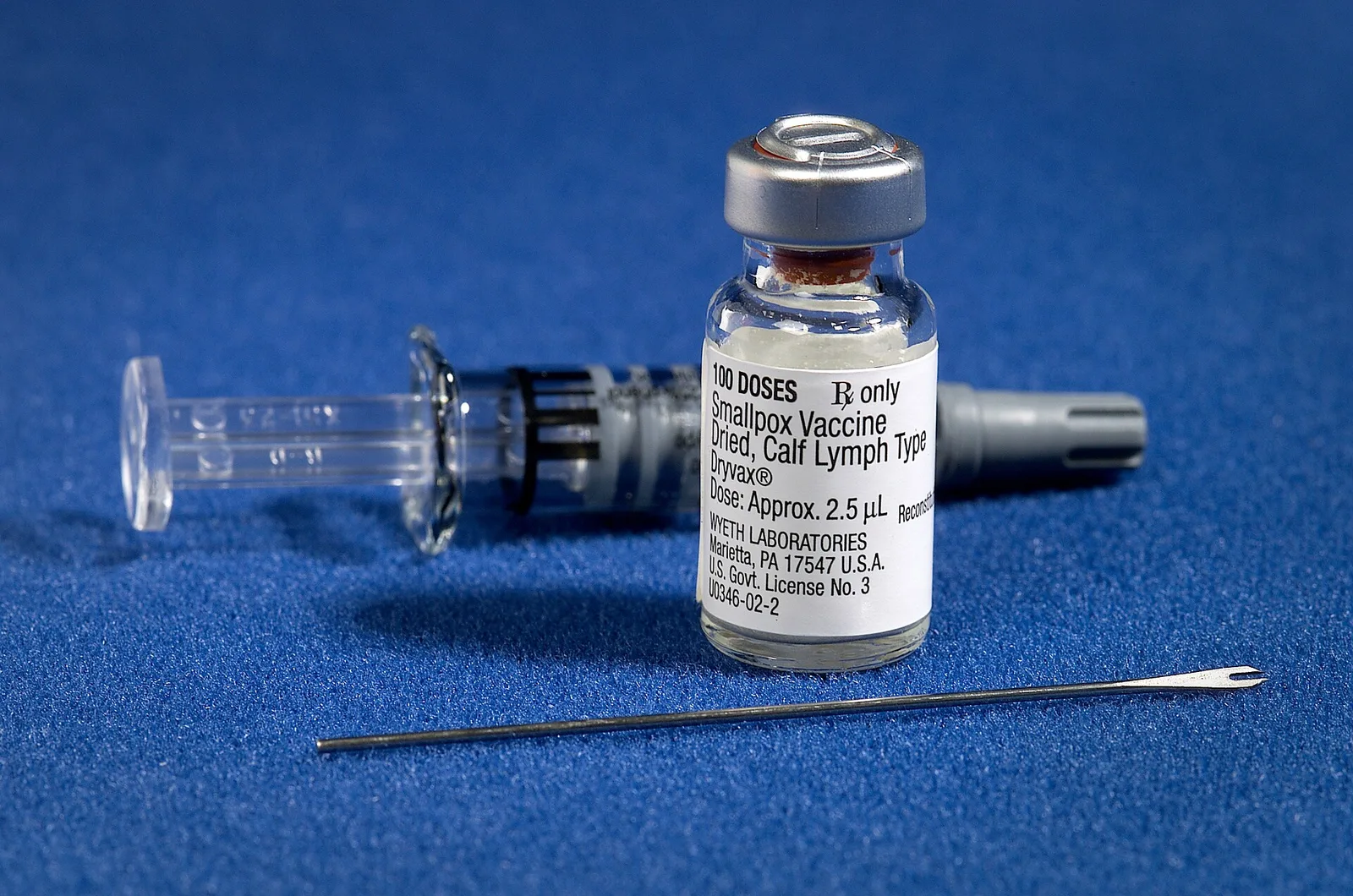
The smallpox vaccine is the first vaccine ever developed against a contagious disease, and it ended a disease that had killed for millennia. In 1796 the British physician Edward Jenner demonstrated that infection with the relatively mild cowpox virus conferred immunity against the deadly smallpox — the word vaccine itself descends from vacca, the cow. The idea had long precursors: variolation, deliberately infecting a patient with material from a smallpox sore, was practiced in Africa and China well before it reached Europe — a Ming text describes blowing powdered scabs into the nose — and it arrived in England through reports from the Ottoman Empire and Lady Mary Wortley Montagu, then through Cotton Mather's Boston. Jenner's cowpox method was safer than variolation and became the template: arm-to-arm transmission, calf lymph, cell culture, attenuated strains. From 1958 to 1977 a World Health Organization campaign took the vaccine around the world and eradicated smallpox — the only human disease ever eradicated. Routine vaccination has stopped, but stocks remain against bioterrorism.
Key facts
- Word origin: 'vaccine' descends from vacca, the Latin for cow, via Jenner's variolae vaccinae — 'smallpox of the cow'.
- Variolation's trade-off: deliberate infection carried a mortality of a fraction of a percent to two percent, against smallpox's own twenty to thirty percent.
- Boston trial: among variolated patients roughly two and a half percent died, against fourteen percent of those who caught the disease naturally.
- Only eradication: smallpox remains the only human disease ever eradicated, by a WHO vaccination campaign.
In depth
Origins and preconditions
Before vaccination there was variolation — deliberately giving a healthy person a real smallpox infection, usually a mild one, to buy immunity. The practice likely arose independently in Africa and China well before Europe: a Ming author describes blowing powdered scabs into the nose, inoculation spread in China under the Longqing reign era, and reports of the Chinese method reached the Royal Society at the start of the eighteenth century. The Ottoman practice reached England through Emmanuel Timoni's reports and Lady Mary Wortley Montagu, who had her own children variolated; in Boston, Cotton Mather learned the technique from Onesimus, a man he held enslaved, and a trial during an epidemic showed variolated patients dying at a sixth the rate of natural infection. It worked — and it killed some of the people it protected. What Jenner added in 1796 was a way to get the immunity without the disease: the milder cowpox.
Vaccination's prehistory is variolation, and variolation's history is global. Chinese and Indian practitioners blew powdered scabs into the nose or scratched smallpox matter into the skin; Ottoman and African traditions practiced similar inoculations; Lady Mary Wortley Montagu brought the Ottoman method to Britain, and Cotton Mather learned it from an enslaved man named Onesimus. The logic was statistical before it was immunological: a deliberate mild infection killed far fewer people than a natural epidemic, even though it killed some. Jenner's cowpox experiment in 1796 replaced that dangerous trade with a safer one — a related virus that protected without causing smallpox.
How it worked
The first vaccine worked by biological cross-protection: infection with cowpox, a related but mild virus, primes the immune system against its deadly relative. From 1796 into the 1880s the vaccine itself was maintained arm to arm — lymph taken from a vaccinated person's sore and carried, with real risk, into the next arm. Maintaining the virus in cattle from the 1840s standardized supply; calf lymph became the leading vaccine, and in the twentieth century vaccinia was grown in cell culture, then attenuated into third-generation strains. First-generation vaccines, grown on the skin of live animals, are what the eradication campaign actually deployed — live, unattenuated vaccinia, effective and rough: fevers, swollen lesions and rare severe complications were the accepted price of abolishing a thirty-percent killer.
The vaccine works by cross-immunity. Cowpox and smallpox are related orthopoxviruses; infection with the milder one produces antibodies and T cells that recognize the deadly one, so the immune system meets smallpox already prepared. Jenner's original method was arm-to-arm passage of lymph; nineteenth-century production moved to calf lymph, and twentieth-century manufacture to cell culture and attenuated strains. The vaccine is live, which is why it produces a visible pustule and why it is not given to the immunocompromised. Its risks — rare encephalitis, progressive vaccinia — are real but small, and they were accepted because the disease it prevented killed roughly a third of those it infected.
Diffusion
Vaccination inherited variolation's routes. From Gloucestershire it followed trade, armies and empires; arm-to-arm transmission let it travel without refrigeration; calf lymph let it scale. The decisive expansion was institutional: from 1958 to 1977 the World Health Organization ran a global campaign — surveillance, ring vaccination, mass production — that took the vaccine to the last natural case of smallpox, making it the only human disease ever eradicated. Routine vaccination stopped after victory, but production never quite did: stocks are maintained against research needs and bioterrorism, and after recent events governments rebuilt stockpiles of a vaccine for a disease that no longer exists in the wild.
Vaccination spread faster than the science that explained it. Jenner published in 1798; within a decade, vaccination had reached the United States, continental Europe and colonial ports, carried by physicians, missionaries and navies. Compulsory laws followed in the nineteenth century, and the twentieth century added the institutional machinery: vaccine production, cold chains, surveillance and ring vaccination. The World Health Organization's eradication campaign (1966–1980) was the culminating act — a global operation that used the vaccine to interrupt every chain of transmission. Smallpox remains the only human disease eradicated by vaccination, and the campaign became the template for later immunization programs.
Impact and legacy
The smallpox vaccine changed the grammar of medicine: it proved that a disease could be abolished rather than merely endured, and it supplied the word — vaccine — for every immunization since. Its predecessor variolation already showed the logic of deliberate infection; Jenner's cowpox made it safe enough to scale; the WHO campaign showed what scaling meant organizationally, coordinating cold chains, surveillance and border control across the Cold War's divide. The costs were real — vaccine complications, coercive laws, and the arms of generations of the vaccinated — but the ledger closes with the only complete victory in the history of medicine. What remains is cautionary and protective at once: stocks in freezers, research programs, and the knowledge that eradication, once achieved, still needs guarding.
The smallpox vaccine is the proof of concept for vaccination itself. It demonstrated that a disease could be not merely treated but abolished, and it gave public health its most powerful tool: prevention at population scale. The eradication campaign trained a generation of epidemiologists, built cold-chain infrastructure and established the ethical and operational template for polio, measles and other campaigns. Its legacy is also cautionary: vaccine hesitancy, unequal access and the risk of deliberate release keep smallpox on the security agenda, and stockpiles are maintained for a disease that no longer circulates. The vaccine's history is thus both a triumph and a standing reminder that eradication is a process that must be maintained.
Timeline
- 1549–1796
Variolation: immunity at a price
Deliberate smallpox inoculation — African, Chinese and Ottoman practice — cuts mortality from the disease's own toll to a small fraction, at the cost of causing real infections.
- 1796–1880
Cowpox and arm-to-arm
Jenner's cowpox demonstration founds vaccination; for most of a century the vaccine itself is transmitted arm to arm between vaccinated people.
- 1796Jenner demonstrates cowpox immunity against smallpox
- 1880–1977
Calf lymph, culture, eradication
Calf lymph standardizes production, cell culture purifies it, and the WHO's global campaign eradicates smallpox — the only human disease ever to be eradicated.
- 1880Calf lymph becomes the leading vaccine
- 1931Vaccinia is first grown in cell culture
- 1967The WHO launches the intensified smallpox eradication campaign
- 1977The last natural smallpox case marks eradication
The last phase ends at its data cut-off; the entity window remains open to the present.
Connections
Related technologies
Related entries chosen for this kind of subject — shared context, place or period.
Sources
- Smallpox vaccine — Encyclopaedia BritannicaAttribution
- Smallpox vaccineWikipedia (EN)CC-BY-SA-4.0
- VariolationWikipedia (EN)CC-BY-SA-4.0
- Wikidata Q1037810 — Smallpox vaccineWikidata · structured dataCC0-1.0
Reuse this data: open dataset (GeoJSON / CSV, CC BY 4.0)