Technology · 1928 – present
Penicillin
青霉素
Origin: London (Fleming's laboratory) ·
Summary
Penicillin is the first mass-produced antibiotic: a group of beta-lactam compounds originally obtained from Penicillium moulds, effective against the staphylococci and streptococci that had long made simple wounds lethal. Alexander Fleming discovered it in 1928 as a crude extract — and coined the name in 1929, to avoid repeating the phrase 'mould broth filtrate'. Turning a mould into a medicine took a war: Cecil Paine treated eye infections with the crude extract; Howard Florey and Ernst Chain's Oxford team purified it in 1940 and treated the first patient the following summer; wartime Britain and the United States then industrialized it — a worldwide search found the best strain on a mouldy cantaloupe in an Illinois market, corn steep liquor fed the fermentation, and Pfizer's deep-tank method, engineered by Margaret Hutchinson Rousseau, made bulk production possible. By mid-1945 production ran to hundreds of billions of units, Allied wound deaths and amputations fell measurably, and the antibiotic era began — now shadowed by the resistance its own success created.
Key facts
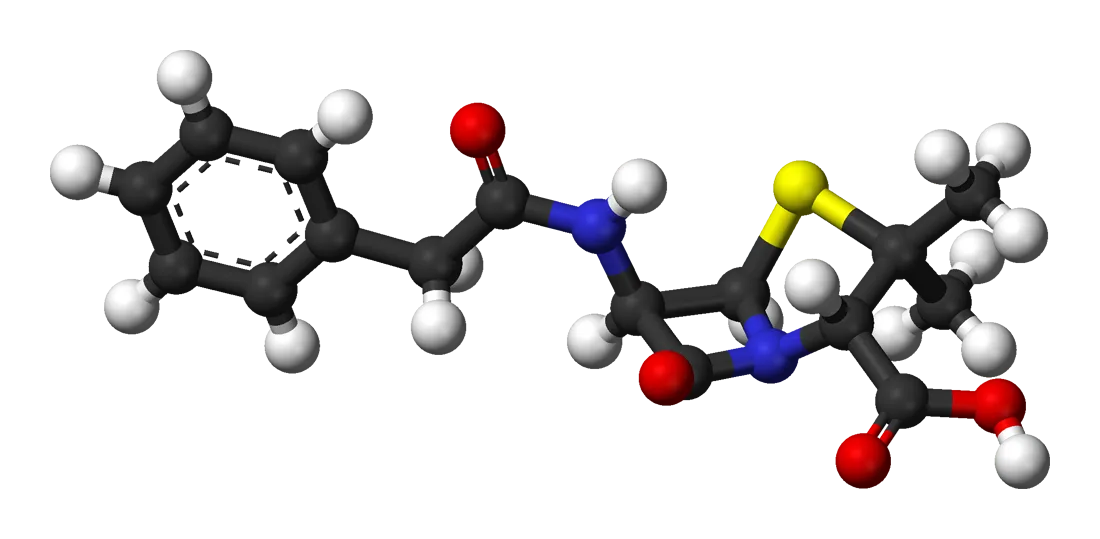
- Class: penicillins are beta-lactam antibiotics, their variants differing by a single side chain that changes spectrum, stability and resistance.
- Naming: Fleming coined 'penicillin' simply to avoid repeating 'mould broth filtrate' in his paper.
- Production: the best strain came from a mouldy cantaloupe found in an Illinois market, producing six times as much as Fleming's mould.
- Wartime effect: among Allied forces it cut deaths and amputations from infected wounds, saving an estimated twelve to fifteen percent of lives.
In depth
Origins and preconditions
Penicillin's story begins with a contaminated plate and a prepared mind. Fleming discovered in 1928 that a mould contaminant — Penicillium rubens — killed bacteria around it, and he published the crude extract's antibacterial power the next year, coining 'penicillin' to avoid repeating 'mould broth filtrate'. But the compound was unstable, hard to isolate, and produced in tiny quantities; Fleming's strain yielded principally penicillin F, the least practical of the natural forms. For years the discovery stayed a laboratory curiosity, rescued by his student Cecil George Paine, who used the crude extract to cure neonatal conjunctivitis. The decisive turn came when the Florey–Chain team at Oxford, funded against the coming war, isolated purified penicillin and demonstrated it clinically — converting a mould's accident into a drug candidate.
Penicillin's discovery is a story about observation and about the limits of observation. Fleming noticed in 1928 that a contaminating mould had cleared a ring in a bacterial culture, and he followed the clue far enough to name the substance and publish its antibacterial action. But he could not purify it or produce it in quantity, and the discovery sat for a decade. The Oxford team — Florey, Chain and their colleagues — turned it into a drug by solving the purification and production problems, and the wartime alliance solved the scale problem. The lesson is that discovery, development and manufacturing are three different achievements, often by different people.
How it worked
Penicillins share a distinct four-membered beta-lactam ring plus a thiazolidine ring, and an R side chain whose shape decides each variant's antimicrobial spectrum, stability and vulnerability to beta-lactamase enzymes. The drugs work by interfering with bacterial cell-wall synthesis — lethal to dividing bacteria, comparatively harmless to the patient. Making them was the engineering problem: the natural product came as an ill-defined amorphous powder whose potency varied by batch, so early medicine was prescribed in 'units' standardized against reference samples, from Oxford units to the international standard stored at Mill Hill. Scale required fermentation at industrial depth: corn steep liquor as feedstock, the Peoria cantaloupe strain for yield, and deep-tank fermentation — suggested by Pfizer's Jasper Kane, engineered by Margaret Hutchinson Rousseau — to replace the shallow trays that could never feed an army.
Penicillin kills bacteria by attacking the cell wall. Its beta-lactam ring binds the enzymes that cross-link peptidoglycan, the mesh that gives a bacterial wall its strength; with the cross-links blocked, the wall weakens and the bacterium bursts under its own osmotic pressure. Human cells have no wall, which is why the drug is selective. The same chemistry is the source of resistance: bacteria produce beta-lactamases that cut the ring, and the medical response — clavulanate inhibitors, semi-synthetic penicillins, later cephalosporins — is a running chemical arms race. Production itself was an engineering triumph: deep-tank fermentation turned a laboratory curiosity into tonnes of drug.
Diffusion
Penicillin crossed the Atlantic as a wartime project. Oxford treated its first patients while Britain lacked the industrial capacity to scale; the United States took over production, and the War Production Board drew up a distribution plan for Allied troops in 1943. A worldwide strain hunt ended in an Illinois market — a mouldy cantaloupe yielding six times Fleming's output — and corn steep liquor from fermentation research multiplied it further. Deep-tank fermentation went industrial in time to have 2.3 million doses ready for the Normandy invasion in the spring of 1944; by June 1945 production reached 646 billion units a year, Australia opened civilian use first, and the United States followed in March 1945. Florey had declined to patent, advised it would be unethical; the methods were patented by others.
Penicillin spread as a wartime priority and then as a global standard. The Oxford team's first patients showed the drug's power and its fragility — supplies ran out before the course was complete, and the infection returned. American industry scaled production with deep-tank fermentation, and by 1944 there was enough for the Normandy campaign; after the war, penicillin became the first antibiotic available to civilians worldwide. The discovery also seeded a research program: soil microbiology, strain selection and semi-synthesis produced a family of penicillins and, later, entirely new classes. Its diffusion was uneven — cost and supply kept it scarce in much of the world for years — but its direction was unmistakable.
Impact and legacy
Penicillin opened the antibiotic era. In the Second World War it made a measurable difference — the article credits it with saving an estimated twelve to fifteen percent of Allied wounded who would otherwise have died of infected wounds — and after it, infections that had routinely killed became routinely curable. The Nobel Prize in Physiology or Medicine of 1945 was shared by Fleming, Florey and Chain, honoring the whole chain from dish to factory. Its very success wrote the next chapter: extensive use bred resistance, and beta-lactamase enzymes now shape prescribing as much as the original spectrum did. Semi-synthetic penicillins — built from the 6-APA core — extended the family against staphylococci, broadened it, and answered Pseudomonas, a running negotiation between mould, chemistry and bacteria that continues today.
Penicillin opened the antibiotic age and changed the human relationship with infection. Wounds, childbirth, pneumonia and surgery became survivable in ways they had not been; life expectancy rose, and medicine gained confidence that infectious disease could be treated rather than merely prevented. The same success created the resistance crisis: every use selects for bacteria that survive, and the pipeline of new antibiotics has slowed. Penicillin's history is therefore both a triumph and a warning — a reminder that the drugs we depend on are a commons that has to be managed, and that the discovery of a molecule is only the beginning of the work of keeping it useful.
Timeline
- 1928–1940
Discovery in a neglected dish
Fleming's crude extract kills bacteria in culture but proves unstable and hard to produce; his student Paine shows it can treat eyes; the discovery sits mostly on the shelf.
- 1928Fleming discovers penicillin's antibacterial power
- 1940–1943
The Oxford purification
Florey and Chain isolate penicillin F and treat first patients; wartime Britain lacks the capacity to scale, so the effort moves to the United States.
- 1940The Oxford team isolates purified penicillin
- 1943–1945
Deep tanks and the invasion
The War Production Board organizes distribution; corn steep liquor and the Peoria cantaloupe strain multiply yields; deep-tank fermentation industrializes the medicine in time for Normandy.
- 1943The Peoria cantaloupe strain and corn steep liquor transform yields
- 19442.3 million doses stand ready for the Normandy invasion
- 1945The Nobel Prize is shared and civilian distribution begins
The last phase ends at its data cut-off; the entity window remains open to the present.
Connections
Contributed to
Related technologies
Related entries chosen for this kind of subject — shared context, place or period.
Sources
- Penicillin — Encyclopaedia BritannicaAttribution
- History of penicillinWikipedia (EN)CC-BY-SA-4.0
- PenicillinWikipedia (EN)CC-BY-SA-4.0
- Wikidata Q12190 — PenicillinWikidata · structured dataCC0-1.0
Reuse this data: open dataset (GeoJSON / CSV, CC BY 4.0)