Technology · 约6000 BC – present
Irrigation
灌溉
Origin: Khuzistan and the Mesopotamian foothills ·
Summary
Irrigation is the controlled application of water to land to grow crops — and for over five thousand years it has been the difference between farming and starvation on dry ground. The earliest known canal irrigation operated at Choga Mami on the Iraqi–Iranian border about 6000 BCE, with evidence in Khuzistan of the same millennium; Mesopotamian farmers kept it running from at least the third millennium BCE. Egyptians tuned basin irrigation to the Nile's flood, storing surpluses behind dikes and in reservoirs; Nubians raised water with the sakia wheel; Persian qanats — wells and gently sloping tunnels that tap groundwater — remain in use across Asia, the Middle East and North Africa to this day. In the Zana Valley of Peru, canals of the fourth and third millennia BCE carry irrigation to the New World's earliest record. Modern pumping turned the scale from millions to hundreds of millions of hectares, with Asia holding most of it; irrigation underwrote the green revolution, but overdrafted aquifers now shadow it.
Key facts
- Methods: surface (gravity) irrigation is the oldest form; sprinkler and micro-irrigation pipe water to where rain cannot reach.
- Basin irrigation: Egyptian engineers enclosed fields with dikes, let the Nile's flood deposit fertile sediment, then returned the surplus to the river.
- Qanats: gently sloping tunnels with vertical wells tap groundwater without pumping — among the oldest irrigation methods still in use.
- Scale: irrigation more than doubled its equipped area within living memory, and roughly a third of global food output comes from irrigated land.
In depth
Origins and preconditions
Irrigation began where rain gave up. Archaeology finds the earliest known canal irrigation at Choga Mami, on the present Iraqi–Iranian border, operating about 6000 BCE, and sixth-millennium evidence in Khuzistan in south-west Iran; Mesopotamian plain farmers used irrigation from at least the third millennium BCE. Persia grew barley with irrigation as early as the sixth millennium BCE, and Egypt practiced basin irrigation on the Nile flood — a system refined, under Amenemhet III, into the management of the Faiyum Oasis as a reservoir. Irrigation is inseparable from the first states: guarding canals, rationing water and settling disputes over headgates gave early governments their daily work, which is why the oldest written administrative records are so often water accounts.
Irrigation and the state grew together, but the causal arrow is disputed. The hydraulic hypothesis once held that large-scale waterworks required centralized authority and therefore produced the first states; later archaeologists pointed out that many canal systems were built by local communities long before kings, and that states often taxed and extended works that already existed. What is not disputed is the administrative consequence: water has to be allocated, scheduled and defended, and those tasks generate records, officials and law. The oldest cadastral and ration texts from Mesopotamia are, in effect, water documents.
How it worked
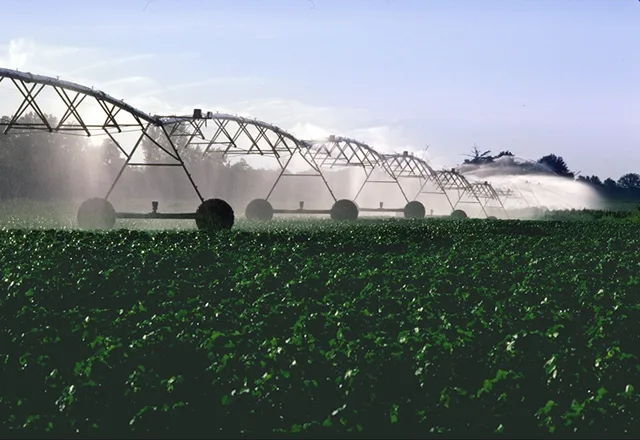
All irrigation moves water from where it is to where the crop is, and the methods differ in how. Surface or gravity irrigation — the oldest — floods furrows and basins and lets soil do the plumbing; Egyptian basins caught the Nile's flood, held it while sediment settled, then drained the surplus back. Lift devices extended it: the Nubian sakia and the noria of Roman North Africa raised water wheel by wheel, with valves fitted to noria pots to smooth their fill. Qanats solved the supply problem differently — a mother well and gently sloping tunnels tapped groundwater and delivered it downhill by gravity alone, a design still working across Asia, the Middle East and North Africa. Modern systems add pressurized pipe: sprinklers throw water overhead, and micro-irrigation drips it at the root, trimming losses that gravity methods accept.
Irrigation engineering is a fight against three losses: evaporation, seepage and runoff. Lining canals, shading water and burying pipes attack the first two; leveling fields and controlling the flow attack the third. Gravity systems are cheap to run but water-hungry; pressurized systems — sprinklers and drip — deliver more precisely but require pumps and energy. The choice is always local: a qanat works where a water table slopes gently; a rice paddy works where water can stand; a center-pivot works where the aquifer is deep and the field is flat. The common failure mode is salinization: every irrigation water carries salts, and unless drainage removes them, the field slowly turns white and unproductive.
Diffusion
Irrigation crossed every arid belt independently. Nubia ran sakia irrigation between the third and second millennia BCE. Persia's qanats, developed about 800 BCE, spread with Persian settlement across Asia, the Middle East and North Africa. Terrace irrigation — a hybrid of the two techniques — appears in pre-Columbian America, Syria, India and China; in Peru's Zana Valley, archaeologists found canals radiocarbon-dated to the fourth and third millennia BCE, the earliest record of irrigation in the New World, with a possible fifth-millennium canal beneath. In the twentieth century the scale changed order of magnitude: pumps and dams pushed equipped area from single-digit millions of hectares to over 350 million, with 71% in Asia, where irrigation fed the green revolution's new varieties.
Irrigation spread with crops and states, but its modern map was redrawn by technology. The green revolution of the 1960s depended on new wheat and rice varieties that only performed with reliable water and fertilizer; governments responded with dams, canals and tube wells, and irrigated area more than doubled. Asia now holds about seventy percent of the world's irrigated land, with China, India and Pakistan dominating. The next chapter is less about expansion than about management: drip irrigation, canal lining and conjunctive use of surface and groundwater are attempts to keep the same area productive with less water, while transboundary rivers make irrigation a foreign-policy problem as much as an engineering one.
Impact and legacy
Irrigation built the earliest surplus economies and the states that taxed them: Mesopotamia's canals, Egypt's basins and Persia's qanats each fed cities that rain-fed farming could not. Its modern expansion re-fed the world — roughly a third of global food now grows on irrigated land — but the mechanism has a bill. Diesel and electric pumps withdraw groundwater faster than aquifers refill, threatening permanent capacity loss, subsidence and degraded water quality across the North China Plain, the Punjab and the American Great Plains. The technology that first let farmers defy drought now faces the harder discipline of living within a water budget, and drainage — irrigation's quiet partner — is being rediscovered as the other half of the same problem.
Irrigation's impact is the difference between famine and surplus. It allowed cities to grow where rain could not feed them, supported the first bureaucratic states, and in the twentieth century fed a doubling of population. But the bill is now coming due: aquifers are being mined faster than they recharge, salinization has damaged fields from Mesopotamia to the Indus, and large dams have displaced millions while altering river ecologies. The twenty-first-century agenda is therefore conservative rather than expansionary — recharge, efficiency, drainage and water pricing — and the political question is who gets the last reliable water.
Timeline
Dates are century precision; years are century starts.
- 6000 BC–1800 BC
The first canals
Farmers dig canals in the Mesopotamian foothills; Mesopotamia's plain carries irrigation from at least the third millennium; Peru's Zana Valley builds the New World's first canals.
- 6000 BCCanal irrigation operates at Choga Mami
- 1800 BC–AD 1800
Basins, sakias and qanats
Egypt times its dikes to the Nile flood and stores surpluses at Faiyum; Nubia raises water with sakias; Persian qanats tap groundwater and spread across Asia, the Middle East and North Africa.
- 1800 BCEgypt manages the Faiyum Oasis as a Nile reservoir
- 800 BCPersian qanats tap groundwater for dry farming
- AD 1800–AD 1960
Pumps, dams and the green revolution
Diesel and electric pumping lift groundwater faster than basins refill; irrigated area grows from single-digit millions of hectares to hundreds of millions, concentrated in Asia, where irrigation underwrites the green revolution.
- AD 1960Irrigation becomes a key component of the green revolution
The last phase ends at its data cut-off; the entity window remains open to the present.
Connections
Used by
Showing the 10 earliest adopters by the adopter's start date (of 115).
Technologies used
Related technologies
Related entries chosen for this kind of subject — shared context, place or period.
Sources
- Irrigation — Encyclopaedia BritannicaAttribution
- IrrigationWikipedia (EN)CC-BY-SA-4.0
- QanatWikipedia (EN)CC-BY-SA-4.0
- Wikidata Q11453 — IrrigationWikidata · structured dataCC0-1.0
Reuse this data: open dataset (GeoJSON / CSV, CC BY 4.0)