Technology · 约300 BC – present
Agricultural terracing
梯田
Origin: The Levant and Yemen Highlands ·
Summary
Agricultural terracing cuts flat platforms into hillsides in stair-step sequences, and it is how mountains became farmland: each terrace slows runoff, holds the shallow soil, and — with a carefully placed outlet — doubles as a channel for irrigation water. The technique is old and multi-origin: terrace systems in the Yemen Highlands were constructed from the third millennium BC, and evidence in the Levant supports terracing as early as the fourth millennium BCE, spreading widely through the Bronze and Iron Ages across the Negev and Petra region. In the South American Andes, farmers built terraces known as andenes — developed by the Wari culture before 1000 AD and adopted by the Inca, whose canals, aqueducts and puquios watered the terraces that fed Machu Picchu. Rice terraces spread across East, South and Southeast Asia; West African groups such as the Dogon terraced steep slopes; Mediterranean hillsides terrace vineyards and olives. The Philippine Cordilleras' rice terraces, still maintained, are recognized as a World Heritage Site for exactly this technique.
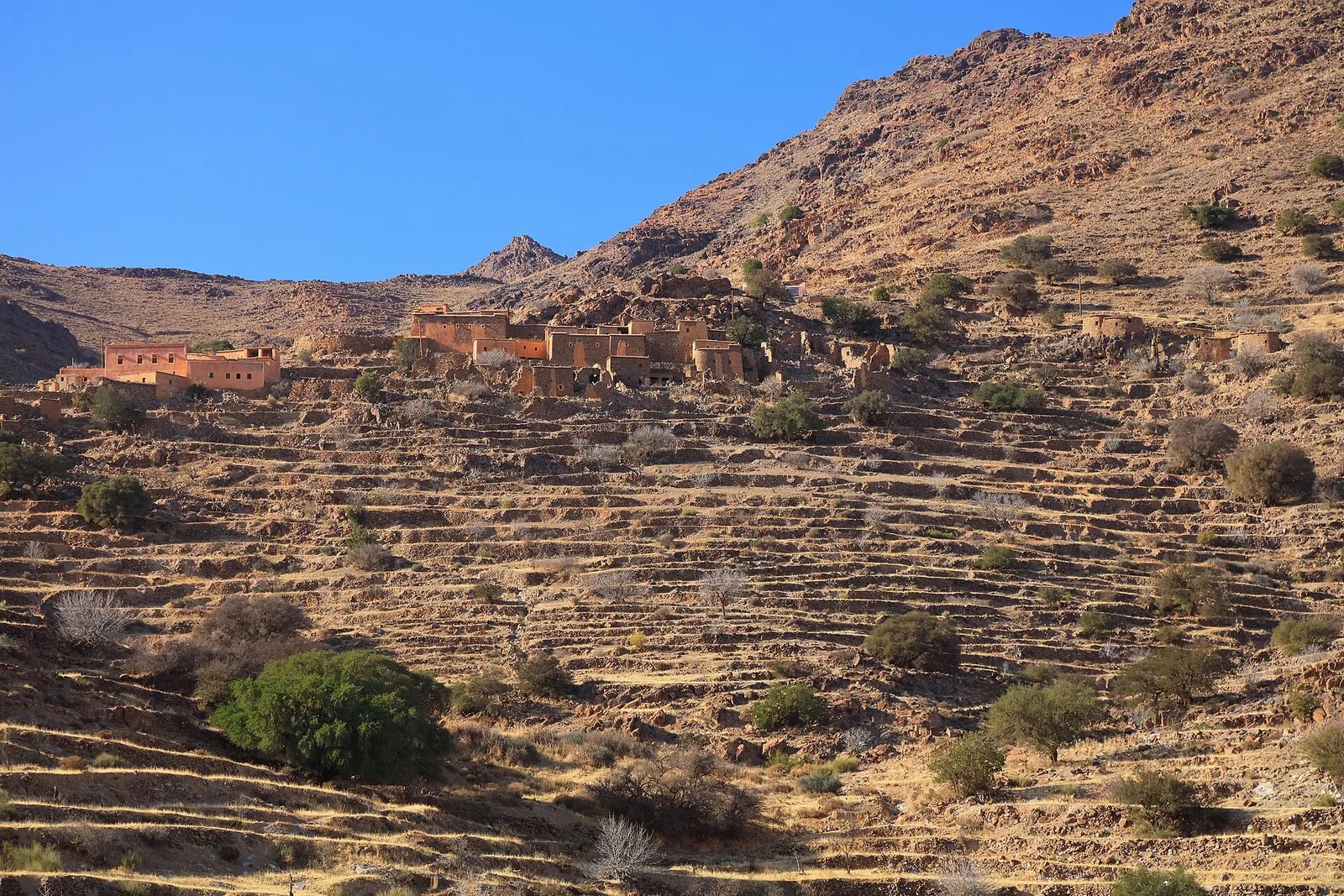
Key facts
- Function: terraces cut erosion and surface runoff, holding shallow mountain soil in place while the stair-step pattern doubles as a channel for irrigation water.
- Andean design: andenes were built to make the most of shallow soil, with outlet structures letting runoff irrigate the crops below.
- Inca additions: canals, aqueducts and puquios — infiltration wells — carried water through dry land to terraces that fed cities such as Machu Picchu.
- Living heritage: the Rice Terraces of the Philippine Cordilleras are still maintained and hold World Heritage status for this technique.
In depth
Origins and preconditions
Terracing answers a simple problem: hills are everywhere, flat land is not, and unworked slopes shed their soil with every rain. The earliest documented terrace systems anchor in the Old World's dry highlands — Levant evidence supports terrace farming as early as the fourth millennium BCE, with widespread implementation through the Bronze and Iron Ages across the Negev Desert and the Petra region, and the Yemen Highlands' systems were constructed from the third millennium BC. From the beginning of the first millennium BC the Kislovodsk basin in the northern Caucasus terraced its slopes, first with the Koban culture and later under Alanic communities. The Hanging Gardens of Babylon may even have been an artificial mountain of stepped terraces — the same logic, turned to display.
Terracing has many birthplaces because the problem is universal. The Andes, the Yemen Highlands, the Mediterranean, the Philippines and west Africa all developed terrace systems independently, often before written records. The archaeological signature is a staircase of stone or earth risers and level platforms, sometimes with drains and footpaths; the social signature is a community that invests years of labor before the first harvest. That is why terraces are often associated with strong local institutions and with landscapes that look engineered because they are: a hillside terrace is a piece of infrastructure as much as a field.
How it worked
A terrace is a wall of earth or stone holding a flat platform of soil against the slope. Hydrologically it does three things at once: it shortens the slope's length so runoff never gains speed, it creates a level basin where water soaks instead of sheeting away, and — with an outlet placed low on the riser — it turns one terrace's surplus into the next one's irrigation. That is why terraces and irrigation keep appearing together, from the Yemen Highlands to the Andes, where the Inca paired andenes with canals, aqueducts and puquios, infiltration wells that feed the terraces through the dry season. The engineering is local and repetitive: level the platform, wall the riser, set the outlet, and repeat upward until the slope is farmland.
A terrace works by slowing water down. The level platform gives rain time to infiltrate; the riser holds the soil that would otherwise wash away; the outlet carries excess water to the next terrace instead of cutting a gully. Maintenance is continuous — a breached riser can fail in one storm — and the system's success depends on collective labor and clear rules about who maintains which section. In the Andes, the Inca added canals and puquios to the andenes; in Asia, paddy terraces hold water for rice itself; in the Mediterranean, dry-stone terraces support olives and vines. The engineering is simple; the social contract is not.
Diffusion
Terracing is one of agriculture's convergent inventions — it appears wherever steep land met dense farming. In the South American Andes, farmers built andenes for over a thousand years; the Wari culture developed them before 1000 AD, and the Inca adopted and extended the system to feed highland cities such as Machu Picchu. Rice terraces spread across east, south, southwest and southeast Asia, where paddy terraces hold water for the crop itself; the Philippine Cordilleras' terraces are a World Heritage Site. West African groups — the Mafa, Ngas, Gwoza and Dogon — terraced steep slopes intensively before the fifteenth century. In the Mediterranean, OSL profiling shows a major intensification of terrace construction between the twelfth and sixteenth centuries, the landscape answer to population growth in hill country.
Terraces spread with farmers, not with empires. Rice terraces moved with rice cultivation across south China, Southeast Asia and the Philippines, where the Cordilleras' terraces were built by Ifugao communities over centuries. In the Andes, terracing expanded under the Wari and then the Inca, who used it to feed highland cities and to manage vertical ecological zones. In the Mediterranean, terrace construction intensified in the late Middle Ages as population pressed on hill country. The modern world has added a new diffusion: terracing as a conservation measure, promoted by development agencies for erosion control, and as heritage tourism, which turns the same slopes into a different kind of resource.
Impact and legacy
Terraces turned perpendicular acres into food, and in doing so set the ceiling of entire highland civilizations: the Inca state fed its cities and armies from terraced slopes that no flat plain could have provided at that altitude. The technique also encoded labor — a terrace is a collective, multi-year investment, which is why terraced landscapes mark regions with strong local institutions, from the Yemen Highlands to the Philippine Cordilleras. Mechanization resisted them for centuries — standard tractors cannot work a twenty-percent slope — until the 1970s, when low-center-of-gravity two-wheel tractors began crossing Alpine pastures, and 2000s designs pushed past twenty percent with harvesters and trailers. The old answer to mountain hunger is thus still being updated, and UNESCO's treatment of the Philippine terraces as heritage rather than machinery marks the newest turn: terraces are now also landscapes worth preserving for their own sake.
Terraces raise the carrying capacity of mountains, and that is their historical importance: they allowed dense populations to live where flat land was scarce, from the Andes to the Philippine Cordilleras. Their limits are equally clear. They are labor-intensive, hard to mechanize and vulnerable to abandonment; when rural populations move to cities, the walls fail within a generation and the slope reverts to scrub. Modern terracing policy therefore mixes conservation, heritage and tourism, and the most successful cases are those where the social institutions that maintained the terraces — water associations, work parties, communal rules — survive alongside the stone.
Timeline
Dates are century precision; years are century starts.
Milestones
- 2500 BCYemen Highlands terrace systems begin construction
- 900 BC–AD 900
Caucasus and Mediterranean hill country
The Kislovodsk basin terraces from the first millennium BC onward; Mediterranean slopes begin their long vine-and-olive tradition.
- 300 BCTerrace farming documented in the fourth-millennium Levant
- AD 900–AD 1400
Andenes and rice highlands
Wari and Inca andenes feed Andean cities; rice terraces cover East and Southeast Asian highlands; West African groups terrace steep slopes.
- AD 900Wari andenes take shape in the Andes before Inca adoption
- AD 1400–AD 1970
Intensification and mountain machines
Mediterranean terracing intensifies in the later Middle Ages; the twentieth century finally brings low-center-of-gravity tractors that can work slopes steeper than twenty percent.
- AD 1400West African groups terrace steep slopes before the fifteenth century
- AD 1970Alpine pasture farms mechanize terraces with low-slung tractors
The last phase ends at its data cut-off; the entity window remains open to the present.
Connections
Related technologies
Related entries chosen for this kind of subject — shared context, place or period.
Sources
- Terrace cultivation — Encyclopaedia BritannicaAttribution
- Rice Terraces of the Philippine CordillerasWikipedia (EN)CC-BY-SA-4.0
- Terrace (earthworks)Wikipedia (EN)CC-BY-SA-4.0
- Wikidata Q838625 — Terrace (earthworks)Wikidata · structured dataCC0-1.0
Reuse this data: open dataset (GeoJSON / CSV, CC BY 4.0)