Technology · 1712 – present
Steam engine
蒸汽机
Origin: Dudley, England ·
Summary
The steam engine turned heat into continuous mechanical work and, in doing so, detached industry from the waterwheel.
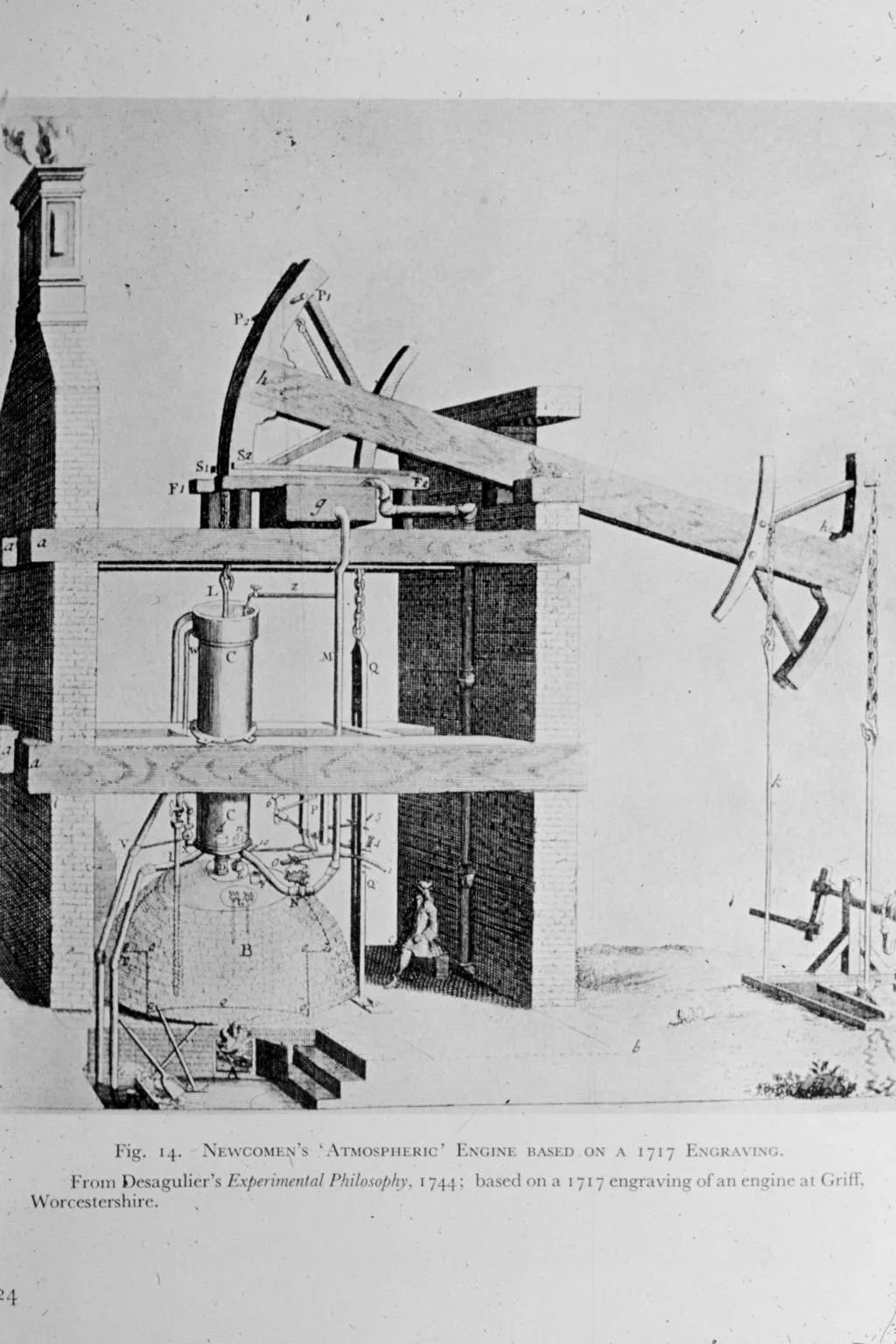
Its decisive form was the atmospheric engine built by Thomas Newcomen in 1712: steam filled a cylinder, condensed, and let air pressure drive a piston that pumped water from mines. James Watt's separate condenser kept the working cylinder hot, cutting coal consumption and making rotary motion practical. Within a century, stationary engines powered factories, locomotives ran on rails and paddle steamers crossed oceans. Reciprocating engines remained the dominant power source until the early twentieth century, when steam turbines took over electricity generation and electric and internal-combustion motors took over transport. Large reciprocating engines are still built for niche uses, but the technology's historic role was to make power portable, schedulable and independent of wind, water or muscle. Its components — boiler, cylinder, piston and condenser — became the template for later heat engines and turbines.
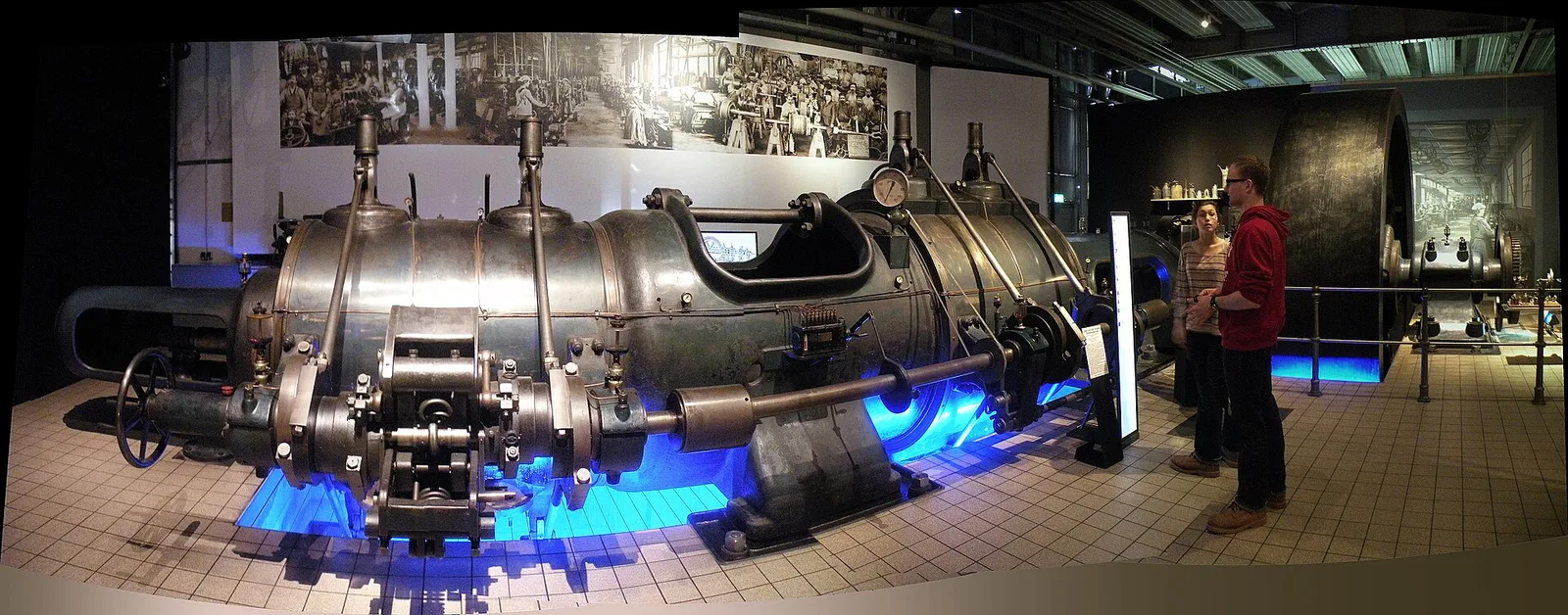
Key facts
- Thermal efficiency: Newcomen engines typically achieved less than 1%, with most coal spent reheating the cylinder.
- Fuel use: the separate condenser moved condensation out of the cylinder, sharply lowering Watt engines’ coal consumption.
- Power density: high-pressure engines shrank small enough for locomotives and ships; stationary engines anchored continuous factory and mine work.
- Displacement: power stations moved to turbines, transport to electric and internal-combustion motors; reciprocating engines retreated to niche uses.
In depth
Origins and preconditions
Steam power began as a mine pump. Flooded coal mines needed to lift water from depths that no horse-driven chain could reach economically, and the cost of fuel at the pithead was low. Thomas Savery's pump used condensing steam to create a vacuum; Thomas Newcomen's atmospheric engine added a piston and cylinder, so that the same vacuum could do work through a beam. Denis Papin's experiments with a piston and steam digester supplied part of the idea, and the early engines were crude but reliable enough to be adopted. Their inefficiency mattered less where coal was cheap and water was the bottleneck.
The steam engine's first market was not factories but water. Coal mines needed to lift water from ever-deeper shafts, and the cost of fuel at the pithead was low enough that efficiency could wait. Savery's pump used condensing steam to create suction; Newcomen's engine added a piston and a beam, turning the same vacuum into a steady up-and-down motion that could drive a pump rod. Watt's separate condenser then broke the link between power and fuel waste, and his rotative engine broke the link between steam and pumping. Each step was less an invention than the removal of a constraint that had made the previous step uneconomic.
How it worked
The atmospheric engine filled a cylinder with steam, then condensed it with a jet of water. The resulting vacuum let external air pressure drive the piston down, and a chain over a rocking beam lifted the pump rod. Because the cylinder was alternately heated and cooled, most of the fuel went into reheating metal rather than doing work. Watt's separate condenser kept the cylinder hot while condensing steam in a second vessel, and a closed cylinder with steam on both sides turned the stroke into rotary motion. Higher-pressure designs later shrank the engine enough for locomotives and ships, at the cost of more dangerous boilers.
A steam engine is a heat engine, and its limit is thermodynamic. Steam at high pressure pushes a piston; the piston turns a crank; the exhausted steam must be condensed so that the cycle can repeat. Watt's insight was that condensing in a separate vessel kept the working cylinder hot, saving the fuel that Newcomen's engine spent reheating iron. Higher pressures and compound expansion — using the same steam in two or more cylinders of increasing size — extracted more work from the same coal, and superheaters pushed the steam above its saturation temperature. The reciprocating engine's efficiency was always modest, but its fuel was cheap and its power was continuous, which is what nineteenth-century industry needed.
 Open original
Diffusion
The technology moved along coal fields, canals and engineering networks. Britain led because it combined cheap coal, deep mines, skilled instrument makers and a patent system that rewarded improvement. Watt's partnership with Matthew Boulton turned the engine into a manufactured product sold to mills, breweries and ironworks. Textile districts adopted rotative engines first; railways and steamships carried the technology to Europe, North America and colonial ports. By the late nineteenth century, engine building was itself an industry, and every industrialising state either imported engines or built its own works under licence.
Steam power spread along coal, capital and skills. Britain led because it had all three: cheap coal, deep mines that demanded pumps, and instrument makers and engineers who could build and repair engines. Boulton and Watt turned the engine into a product sold with a license and a mechanic; textile districts, breweries and ironworks became its first customers. Railways and steamships then carried it beyond the coalfields, and by the late nineteenth century every industrializing state had either imported engines or built its own works. The technology's geography was never uniform: it followed the coal, and the coal followed the geology.
Impact and legacy
Steam made power portable and schedulable. Factories no longer had to sit beside a falling stream, railways could cross mountains, and ships could keep time independent of wind. The result was not just faster production but a new geography of industry, cities and coal transport. The engine also changed work: skilled engine minders and mechanics became a new occupational group, while boiler explosions made safety regulation part of industrial politics. Reciprocating engines were eventually displaced by turbines and electric motors, but the principle — converting heat into controlled motion — remains the basis of modern power generation.
Steam made power a commodity. Factories no longer had to sit beside a falling stream, mines could go deeper, ships could keep a schedule and railways could cross mountains. The social consequences were as large as the engineering ones: industrial cities grew around coal and rail, a new class of engine minders and mechanics appeared, and boiler explosions made safety regulation a political issue. The reciprocating engine was eventually displaced by turbines and electric motors, but its principle — convert heat into controlled motion — remains the basis of modern power generation, and its image still stands for the Industrial Revolution itself.
Timeline
- 1712–1769
Atmospheric pumping engines
Newcomen engines use a condensing vacuum and a piston to pump water from coal mines. They are inefficient but reliable where coal is cheap.
- 1712Newcomen's atmospheric engine is erected at Dudley
- 1769–1804
The separate condenser
Watt keeps the cylinder hot and condenses steam in a second vessel, cutting fuel use and making rotative power practical for mills.
- 1769Watt patents the separate condenser
- 1804–1884
Railways and factories
High-pressure engines become small enough for locomotives and ships; stationary engines anchor the industrial city.
- 1804Trevithick's steam locomotive runs on rails
- 1884–1922
Turbines and displacement
Steam turbines take over power generation; electric and internal-combustion motors displace reciprocating engines in transport.
- 1884Parsons builds a practical steam turbine
- 1922Stationary steam engine efficiency reaches its practical peak
The last phase ends at its data cut-off; the entity window remains open to the present.
Connections
Influenced
Technologies used
Contributed to
Related technologies
Related entries chosen for this kind of subject — shared context, place or period.
Sources
- Steam engine — Encyclopaedia BritannicaAttribution
- Newcomen atmospheric engineWikipedia (EN)CC-BY-SA-4.0
- Steam engineWikipedia (EN)CC-BY-SA-4.0
- Wikidata Q12760 — Steam engineWikidata · structured dataCC0-1.0
Reuse this data: open dataset (GeoJSON / CSV, CC BY 4.0)