Technology · 1860 – present
Internal combustion engine
内燃机
Origin: Europe (Belgian and German workshops) ·
Summary
An internal combustion engine is a heat engine in which fuel burns with an oxidizer inside the engine itself, and the expanding hot gas applies force directly — to pistons, turbine blades, a rotor, or a nozzle. That one change of architecture freed machines from the boiler: where the steam engine carried its fire outside, the internal combustion engine carried it inside, and the difference was weight. The commercially successful line begins in the mid-nineteenth century with Barsanti and Matteucci's gas patents and Lenoir's gas engine; Nicolaus Otto's compressed-charge four-cycle engine of 1876 set the modern pattern, built with Gottlieb Daimler and Wilhelm Maybach. Karl Benz patented a reliable two-stroke gasoline engine and in 1886 began the first commercial production of motor vehicles; Rudolf Diesel's compression-ignition engine followed in 1892. The engine then spread everywhere: automobiles, motorcycles, ships, locomotives, aircraft, tanks, and — in continuous-combustion form — gas turbines, jets and rockets, whose first liquid-fuel flight and first jet aircraft belong to the same lineage.
Key facts
- Architecture: combustion happens inside the working chamber — pistons, turbine blades, rotors or nozzles take the expanding gas's force directly.
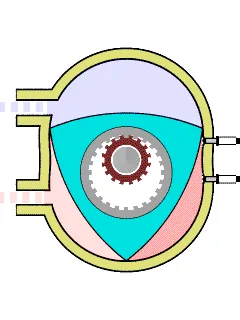
- Two families: intermittent combustion (piston engines, Wankel) versus continuous combustion (gas turbines, jets, rockets) — same principle, different pacing.
- Fuels: hydrocarbons dominate — gasoline, diesel, natural gas — but Diesel ran early engines on peanut oil, and renewable blends are now common.
- Efficiency ceiling: combined-cycle plants built on the same combustion reach roughly half of the fuel's energy as electricity.
In depth
Origins and preconditions
The steam engine dominated the nineteenth century's power supply, and its weakness was architectural: the fire lived in a boiler, the work in a cylinder, and all the weight between them went where the engine went. Putting combustion inside the working chamber promised power without that overhead. Early attempts — Barsanti and Matteucci's 'motive power by the explosion of gases', patented in Britain from 1854 — established the idea; Étienne Lenoir's gas-fired engine of 1860 made it commercially real, if inefficient. The decisive redesign came from Nicolaus Otto: after patenting an atmospheric gas engine in 1864, he worked with Gottlieb Daimler and Wilhelm Maybach to patent the compressed-charge four-cycle engine in 1876, whose compression of fuel and air before ignition is the pattern nearly every piston engine still follows.
The internal combustion engine's ancestors are the gas engine and the bicycle workshop. Lenoir's 1860 engine ran on coal gas and was inefficient but commercially real; Otto's four-stroke cycle of 1876 compressed the charge before ignition, which raised both power and efficiency and defined the modern piston engine. Diesel's compression-ignition engine of 1892 removed the spark altogether, using the heat of compressed air to ignite fuel. The pattern is typical of the industrial revolution: a series of small, patentable improvements, each solving a specific problem — ignition, compression, fuel delivery, cooling — rather than one heroic breakthrough.
How it worked
All internal combustion engines do the same three things: mix fuel with an oxidizer, burn it inside the engine, and let the expanding gas push on something. In piston engines the push moves a piston down a cylinder, a crankshaft turns reciprocation into rotation, and rings seal the chamber against blow-by; four-stroke designs separate intake, compression, power and exhaust into distinct strokes, while two-strokes pack the cycle tighter. Compression is the efficiency lever: Otto's compressed charge burned far harder than Lenoir's uncompressed mixture, and Diesel went further — compressing air alone until its heat ignited injected fuel, no spark required. In continuous-combustion engines the same chemistry drives turbines instead of pistons, and in rockets and jets the exhaust itself provides the push. The rewards are power density and quick response; the costs are heat, noise and emissions that steam engines never ventilated so directly.
The engine's thermodynamics are a cycle repeated thousands of times a minute. Air and fuel are mixed, compressed, ignited and exhausted; the expanding gas pushes a piston, the piston turns a crankshaft, and the flywheel smooths the pulses. Compression ratio is the efficiency lever: the more the charge is compressed before ignition, the more work each explosion extracts. Spark-ignition engines limit compression to avoid knock; diesel engines compress air alone until it is hot enough to ignite injected fuel, which is why they are heavier but more efficient. Continuous-combustion variants — gas turbines, jets, rockets — use the same chemistry without pistons, and the choice between them is a choice about speed, weight and fuel.
Diffusion
The engine's spread followed the Vehicle, the ship and the sky. George Brayton's liquid-fuel engine of 1872 showed hydrocarbons could drive it; Karl Benz patented a reliable two-stroke gasoline engine in 1879 and in 1886 began the first commercial production of motor vehicles — a three-wheeled, four-cycle engine and chassis as one unit. Rudolf Diesel's compression-ignition engine of 1892 gave the type its heavy-duty branch, powering ships, locomotives and trucks. Piston aero engines carried early aviation; in continuous-combustion form the lineage reached upward — Robert Goddard launched the first liquid-fuelled rocket in 1926, and in 1939 the Heinkel He 178 flew as the world's first jet aircraft. Stationary engines, meanwhile, powered farms, factories and, as generator sets, the electrification of places the grid never reached.
The engine spread by fitting the vehicle. Benz's 1886 motor vehicle and Ford's assembly line made the automobile a mass product; Diesel's engine powered ships, locomotives and trucks; piston aero engines carried early aviation, and the jet engine took over long-haul flight after 1945. Stationary engines electrified farms and factories beyond the grid, and generator sets still do. The diffusion was shaped by fuel infrastructure as much as by engineering: gasoline, diesel, kerosene and later jet fuel each built a distribution network, and the engine's geography followed the refinery and the road.
Impact and legacy
The internal combustion engine re-made the geography of power. Freed from boilers and rails, it put a factory's worth of energy into a car, a tractor, a fishing boat and a fighter aircraft; cities sprawled around its range, agriculture mechanized on its torque, and the twentieth century's wars ran on its fuel supply. Its continuous-combustion descendants carry the same story upward — airliners, warplanes and orbital rockets are all this engine's logic at altitude. The bill is equally structural: hydrocarbon combustion concentrates emissions in cities and drives the carbon account of transport, which is why electrification now contests its domain. As a technology it remains the most widely deployed heat engine in history, and its history — gas to gasoline to compression ignition to jet — is a standing lesson in how a single architectural idea scales across a century.
The internal combustion engine reorganized distance. It put a factory's worth of power into a car, a tractor, a fishing boat and a fighter aircraft; cities sprawled around its range, agriculture mechanized on its torque, and the twentieth century's wars ran on its fuel. Its costs are structural: hydrocarbon combustion concentrates emissions in cities, and transport is now a leading contributor to climate change. Electrification is contesting its domain, starting with cars and buses, but the engine remains the most widely deployed heat engine in history — and its continuous-combustion descendants still carry the story into the air and into orbit.
Timeline
- 1860–1876
Gas engines in the workshop
Lenoir's gas engine and Brayton's liquid-fuel design show commerce is possible; atmospheric engines still limp with low compression.
- 1860Lenoir's gas engine begins commercial internal combustion
- 1876–1892
The four-cycle standard
Otto's compressed-charge engine makes internal combustion efficient enough to displace steam in small power; Benz turns it into vehicles; Diesel designs compression ignition.
- 1876Otto patents the compressed-charge four-cycle engine
- 1886Benz begins commercial motor-vehicle production
- 1892–1939
Everywhere and ever upward
Diesel engines power ships and trucks; piston engines lift aircraft; the same combustion principle continues into gas turbines, jets and rockets.
- 1892Diesel develops compression ignition
- 1939The first jet aircraft flies on continuous internal combustion
The last phase ends at its data cut-off; the entity window remains open to the present.
Connections
Related technologies
Related entries chosen for this kind of subject — shared context, place or period.
Sources
- Internal-combustion engine — Encyclopaedia BritannicaAttribution
- Internal combustion engineWikipedia (EN)CC-BY-SA-4.0
- Otto engineWikipedia (EN)CC-BY-SA-4.0
- Wikidata Q12757 — Internal combustion engineWikidata · structured dataCC0-1.0
Reuse this data: open dataset (GeoJSON / CSV, CC BY 4.0)