Technology · 约300 – present
Stirrup
马镫
Origin: China (Jin dynasty) ·
Summary
The stirrup is a light ring hung from the saddle to hold the rider's foot — a small part with outsized consequences. Precursors came first: riders in India used toe loops by the second century BC, and single mounting aids followed, but the paired stirrup proper was invented in China during the fourth century, spread through China by the fifth, and crossed Eurasia to Europe with the nomadic peoples of Central Asia by the seventh or eighth century. Mounted warfare was never the same: a braced rider could lean, strike and stay mounted, delivering blows that used the full weight and momentum of horse and rider — the article calls it one of the most significant inventions in the history of warfare prior to gunpowder, the third revolutionary step in equipment after the chariot and the saddle. It also changed daily life wherever horses worked. One famous claim, however, needs care: historians now argue the stirrup did not enable the couched lance — cataphracts had charged with lances long before; it was the cantled saddle that did that work.
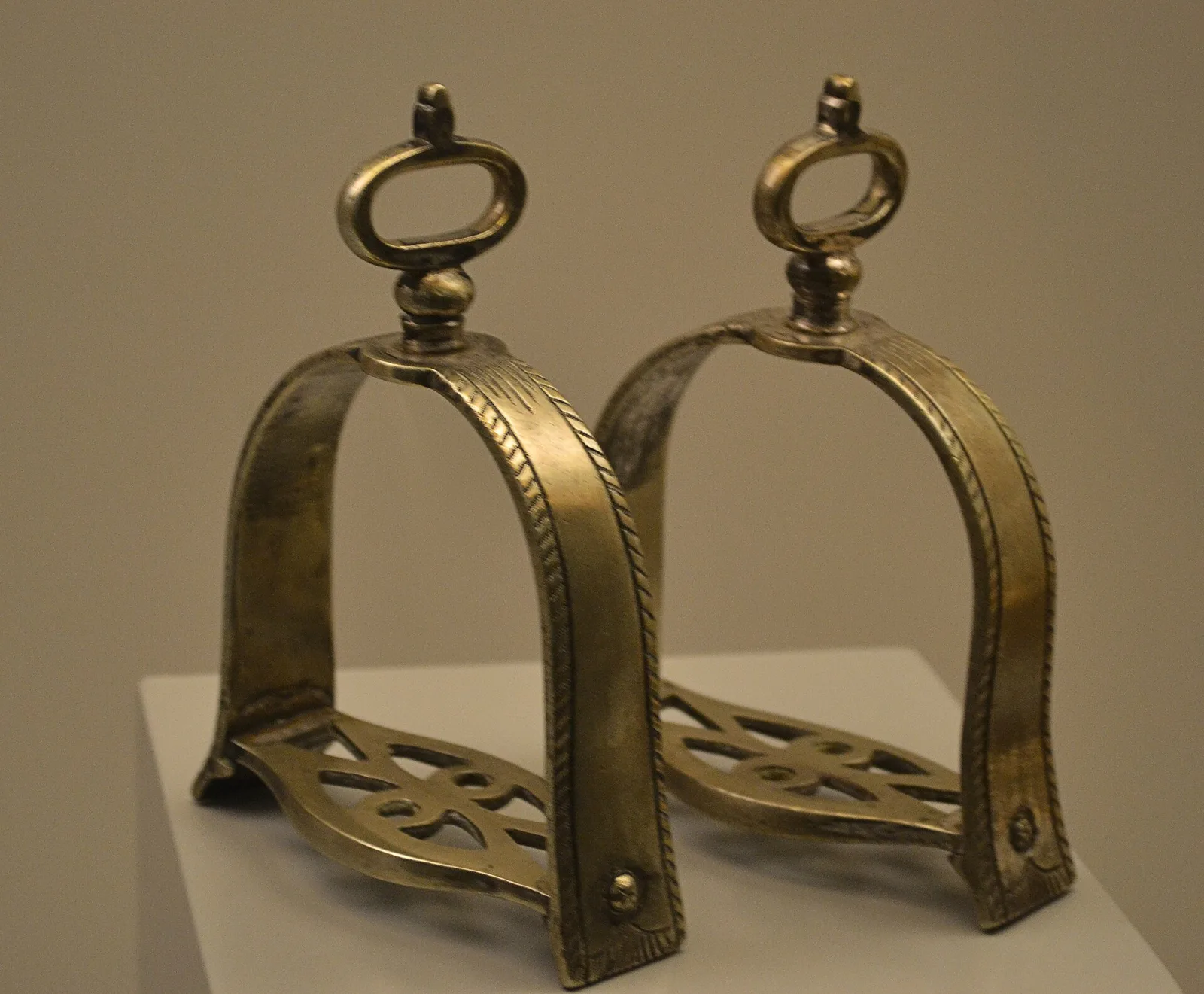
Key facts
- Function: stirrups brace the rider, letting them mount easily and strike with the weight and momentum of horse and rider combined.
- Lineage: toe loops appeared in India, single mounting aids followed, and the paired stirrup came only after the treed saddle.
- Standing: historians rank it among the most significant inventions in the history of warfare prior to gunpowder.
- Myth check: stirrups did not enable the couched lance — cataphracts charged with lances long before; the cantled saddle did that work.
In depth
Origins and preconditions
Getting a rider stably onto a horse took centuries of partial solutions. Indian riders used toe loops by the second century BC; a single foot support served as a mounting aid; and only after the treed saddle — a rigid frame under the rider — did the paired stirrup appear, invented in Chinese Jin territory during the fourth century. The article's framing is deliberate: the stirrup is the third revolutionary step in mounted equipment, after the chariot and the saddle, not a lone flash of genius. Its power is mechanical modesty: a light ring that turns the horse's motion from something a rider survives into something a rider aims.
The stirrup's prehistory is a sequence of partial solutions rather than a single moment. A rider can mount without one; a toe loop or a single hanging strap helps; a rigid treed saddle keeps the rider from sliding; only the paired iron or bronze loop turns the leg into a brace. The Chinese Jin-dynasty evidence of the fourth century is the earliest secure date for the pair, and the Silk Road corridor explains how the idea travelled west. The old claim that the stirrup was invented in India or by the Scythians is not supported by the surviving evidence; what is clear is that the paired stirrup is a Chinese innovation that became Eurasian.
How it worked
The stirrup's mechanics are leverage at the foot. Braced in two rings, a rider's legs take the horse's acceleration, letting the upper body lean, rise and swing a weapon without losing the saddle. That converts momentum into usable force: a strike can carry the full weight of horse and rider, and a rider can fight — especially against infantry — without the constant fear of falling. What it did not do, modern scholarship insists, is unlock the couched lance: armored lancers had existed since antiquity, and the deep saddle with cantle, not the stirrup, is what anchors a lance charge. The stirrup's real gifts are balance, mounting and endurance — unglamorous, decisive.
The stirrup's biomechanics are about bracing, not magic. Standing in two loops lets a rider absorb the horse's acceleration through the legs, freeing the torso to lean, rise and strike; it also delays fatigue on long rides and makes mounting a loaded horse safer. The stirrup works only in combination with a firm saddle and a bridle: a loop on a loose cloth would simply pull the rider sideways. That is why the paired stirrup followed the treed saddle rather than preceding it, and why its military effect was gradual — it improved what cavalry could already do rather than creating a new arm overnight.
Diffusion
The stirrup moved with the steppe. Common across China by the fifth century, it travelled the nomadic corridors of Central Eurasia and reached Europe by the seventh or eighth century — the same channel that later carried the chariot's heirs and the compound bow. Its acceptance reshaped the mounted arm everywhere it went: riders braced by stirrups could wear heavier equipment, ride longer, and fight in formation. The article deliberately spreads the credit — communication, transportation and warfare all improved, since a stirrup helps any rider, not only a soldier; the same ring that steadied a lancer steadied a courier, a herder and a courier of the silk trade.
The stirrup crossed Eurasia along the routes of horses, soldiers and merchants. It was common in China by the fifth century, appears in Korean and Japanese equipment soon after, and reached the steppe and the Byzantine world through the same corridors that carried the composite bow. In Europe it was established by the eighth century, and its pairing with the high saddle, stirrup and lance became the material basis of the mounted knight. The Islamic world adopted it early and used it in both cavalry and courier service. What travelled was not just the object but the posture — a new way of sitting, fighting and travelling on a horse.
Impact and legacy
The stirrup is a classic case study in how technology makes history — and how historians then overclaim it. For decades an influential thesis held that stirrups created the feudal knight by enabling the shock lance charge; the article's historiography notes the correction: cataphracts had charged with lances since antiquity, and the cantled saddle, not the stirrup, anchors the lance. What the stirrup actually did was broad and structural — it made mounted warfare sustainable, riders survivable, and horses usable across communication, transport and farming. As a simple machine with complex consequences, it stands with the stirrup-shaped lessons of technological history: small parts, adopted widely, reorganize armies, economies and landscapes without ever appearing to.
The stirrup's historians have fought harder than its riders. A famous thesis made it the cause of feudalism by enabling the couched lance; later scholarship showed that armored lancers charged long before the stirrup and that the high saddle, not the loop, anchors a lance. What survives is a more modest and more interesting claim: the stirrup made mounted life easier, safer and more sustainable, and therefore helped cavalry become the dominant arm of the post-classical world. It is a case study in how a small piece of hardware can reshape tactics, social status and the cost of war — without ever being the single cause of any of them.
Timeline
Dates are century precision; years are century starts.
- 300–450
The paired stirrup
Invented in Jin China after the treed saddle, the paired stirrup is in common use throughout the country within a century or so.
- 300Paired stirrups invented in Jin-dynasty China
- 450–800
Across the steppe
Nomadic riders carry stirrups across Central Eurasia; by the seventh or eighth century they reach Europe, where mounted warfare reorganizes around braced riders.
- 450Stirrups in common use throughout China
- 700Nomadic peoples carry stirrups across Central Eurasia
- 800Stirrups reach Europe; the braced rider reshapes mounted warfare
The last phase ends at its data cut-off; the entity window remains open to the present.
Connections
Used by
Showing the 10 earliest adopters by the adopter's start date (of 11).
Related technologies
Related entries chosen for this kind of subject — shared context, place or period.
Sources
- Stirrup — Encyclopaedia BritannicaAttribution
- Jin dynasty (266–420)Wikipedia (EN)CC-BY-SA-4.0
- StirrupWikipedia (EN)CC-BY-SA-4.0
- Wikidata Q191657 — StirrupWikidata · structured dataCC0-1.0
Reuse this data: open dataset (GeoJSON / CSV, CC BY 4.0)