Technology · 1856 – present
Bessemer process
贝塞麦炼钢法
Origin: England (Henry Bessemer's patent) ·
Summary
The Bessemer process was the first inexpensive industrial method for mass-producing steel from molten pig iron — and it made the steel age possible. The principle is elegant: blast air through molten pig iron, and the oxygen burns out the excess carbon and impurities, with the oxidation itself keeping the metal molten. Henry Bessemer patented the process in England in 1856; William Kelly is said to have discovered the same idea independently in 1851. Because the converter removes virtually all carbon, steelmakers add a measured amount back — around a quarter of one percent for construction steel. Steel then cost a fraction of what it had, and the world rebuilt itself in the new material: rails strong enough for heavier trains, bridges, ships, girders, wire. The open-hearth furnace eventually displaced the Bessemer converter, but the cheap steel it introduced underwrote railways, skyscrapers and industrial warfare — an entire material age bears its signature.
Key facts
- Principle: air blown through molten pig iron burns out excess carbon and impurities — and the oxidation's own heat keeps the metal molten.
- Recipe: the converter removes virtually all carbon, so steelmakers add a measured amount back; construction steel runs about a quarter of one percent.
- Priority: William Kelly is said to have found the same process independently before Bessemer's patent.
- Name: the process lent its name to American steel towns — Bessemer, Alabama among them.
In depth
Origins and preconditions
Steel before Bessemer was expensive: crucible steel served cutlery and tools, and wrought iron carried the structures of the day. Bessemer, an inventor with a streak for practical engineering, attacked the cost problem directly — why burn coal for hours refining iron when oxygen could do it in minutes? His insight was that air blown through molten pig iron would oxidize carbon and silicon, and that the heat released by that oxidation would keep the charge liquid rather than freezing it into a lump. He patented the process in 1856; the American William Kelly is said to have arrived at the same principle independently in 1851. The idea's brilliance was economical as much as chemical: decarburization took minutes instead of days.
Bessemer's insight was that the fuel could be the air. Pig iron carries carbon and silicon; blowing air through the melt burns them out and releases enough heat to keep the charge liquid, so no external fuel is needed. That single fact turned steelmaking from a slow, fuel-hungry craft into a minutes-long conversion. The process was patented in 1856, but its commercial success depended on two fixes: Mushet's addition of spiegeleisen to restore carbon and remove sulfur, and Göransson's Swedish converter design that made the blast reliable. The invention was a principle; the industry was built by the corrections.
How it worked
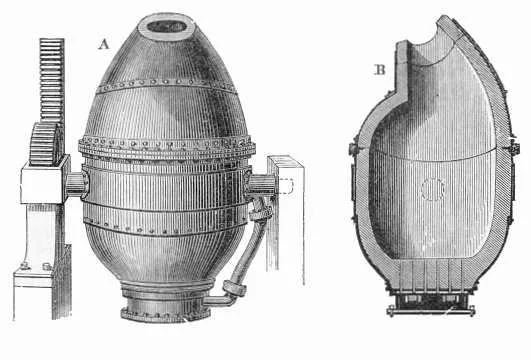
A Bessemer converter is a pear-shaped vessel lined with refractory, charged with molten pig iron, then rotated to blow air through the melt. Carbon, silicon and manganese burn out in a roaring sequence — the converter's flame literally changes color as each element oxidizes — and the process ends when the iron is nearly carbon-free. That 'nearly zero' is the catch: steel is iron with controlled carbon, so the operator adds back a measured amount, roughly a quarter of one percent for construction grades. The chemistry is self-heating, which is why the process needed no external fuel — the decisive economic fact. Its limitation was chemical too: the acidic converter could not remove phosphorus from ores that carried it, so Bessemer works depended on suitable non-phosphoric iron, and the later basic lining solved that constraint.
The converter is a batch reactor with a violent temperament. Air is blown through tuyeres near the bottom; silicon and manganese oxidize first, then carbon, and the flame's colour tells the operator which stage the heat has reached. When the carbon is nearly gone, the vessel is tilted, the steel poured, and a measured amount of carbon and manganese added back — steel is not pure iron but iron with a controlled carbon content. The chemistry is fast and self-heating, but it is also indiscriminate: the acidic lining cannot remove phosphorus, so the process depended on low-phosphorus ore until basic linings and the open-hearth furnace broadened the feedstock.
Diffusion
The process met early resistance: established steelmakers, testing it with unsuitable iron, failed publicly, and Bessemer built his own works at Sheffield to prove it with the right ore. Once demonstrated, adoption was fast where ores allowed — Britain first, then the United States, whose great iron ranges fed converter mills, and continental Europe. Rail was the killer application: Bessemer steel rails carried heavier trains for years longer than iron ones, and the price collapse turned railways' budgets from iron accounting to steel accounting. Cities followed — girder frames, elevated lines, bridges — and shipbuilders moved to steel hulls as plate costs fell. By the end of the century the converter had made steel the default structural metal of the industrial world.
The process spread along the railways. Bessemer steel rails outlasted iron ones and carried heavier trains, and as the price fell, railways, bridge builders and shipyards switched. Britain led, then the United States — whose Mesabi ores were ideal — and continental Europe; Sweden's high-phosphorus ores forced the basic process, and the open-hearth furnace later handled scrap and mixed ores better. The converter also travelled to India, Japan and elsewhere as steel became the measure of industrial capacity. By the early twentieth century, steel output had become a standard index of national power, and the Bessemer principle was its founding method.
Impact and legacy
The Bessemer process collapsed the price of steel and thereby re-priced everything made of it: rails, bridges, ships, frames, wire, armor. Railways grew heavier and cheaper; the first skyscrapers stood on steel skeletons; navies rebuilt in plate steel. Its economic signature is the shift from steel-as-luxury to steel-as-infrastructure — a material age. The process also taught industrial chemistry a lesson it kept: controlling air, lining and ore made steelmaking a science of variables. Its displacement was slow and honorable — open-hearth furnaces handled scrap and phosphoric ores better, and later basic oxygen steelmaking took the final crown — but the Bessemer converter remains the hinge at which steel stopped being expensive.
Bessemer steel re-priced the built world. Railways grew heavier and cheaper, bridges spanned further, ships moved from iron to steel plate, and the first skyscrapers stood on steel skeletons. The process also changed the geography of industry: steelmaking clustered near ore, coal and rail, and the great steel districts — Sheffield, Pittsburgh, the Ruhr — became laboratories of industrial society. Its displacement was gradual — open-hearth furnaces, then basic oxygen steelmaking — but the Bessemer converter remains the hinge at which steel stopped being a luxury and became infrastructure, and at which the modern materials economy begins.
Timeline
- 1856–1867
Patent and first works
Bessemer demonstrates the converter and builds his own works after skeptical steelmakers fail with unphosphoric iron; the process needs the right ore.
- 1856Bessemer patents the converter process
- 1867–1900
The cheap steel age
Converters spread through Europe and North America; rail, shipbuilding and construction rebuild in cheap steel; competition with the open hearth begins.
- 1867American mills adopt the converter
- 1900–1960
Displaced by the open hearth
Open-hearth furnaces, which handle scrap and varied ores better, gradually take over; Bessemer converters wind down by the mid-twentieth century.
- 1900Cheap steel underwrites railways, ships and skylines worldwide
- 1960The last Bessemer converters wind down against the open hearth
The last phase ends at its data cut-off; the entity window remains open to the present.
Connections
Related technologies
Related entries chosen for this kind of subject — shared context, place or period.
Sources
- Bessemer process — Encyclopaedia BritannicaAttribution
- Bessemer processWikipedia (EN)CC-BY-SA-4.0
- Henry BessemerWikipedia (EN)CC-BY-SA-4.0
- Wikidata Q334055 — Bessemer processWikidata · structured dataCC0-1.0
Reuse this data: open dataset (GeoJSON / CSV, CC BY 4.0)