Technology · 150 BC – AD 500
Roman concrete
罗马混凝土
Origin: Rome and the Bay of Naples (pozzolana country) ·
Summary
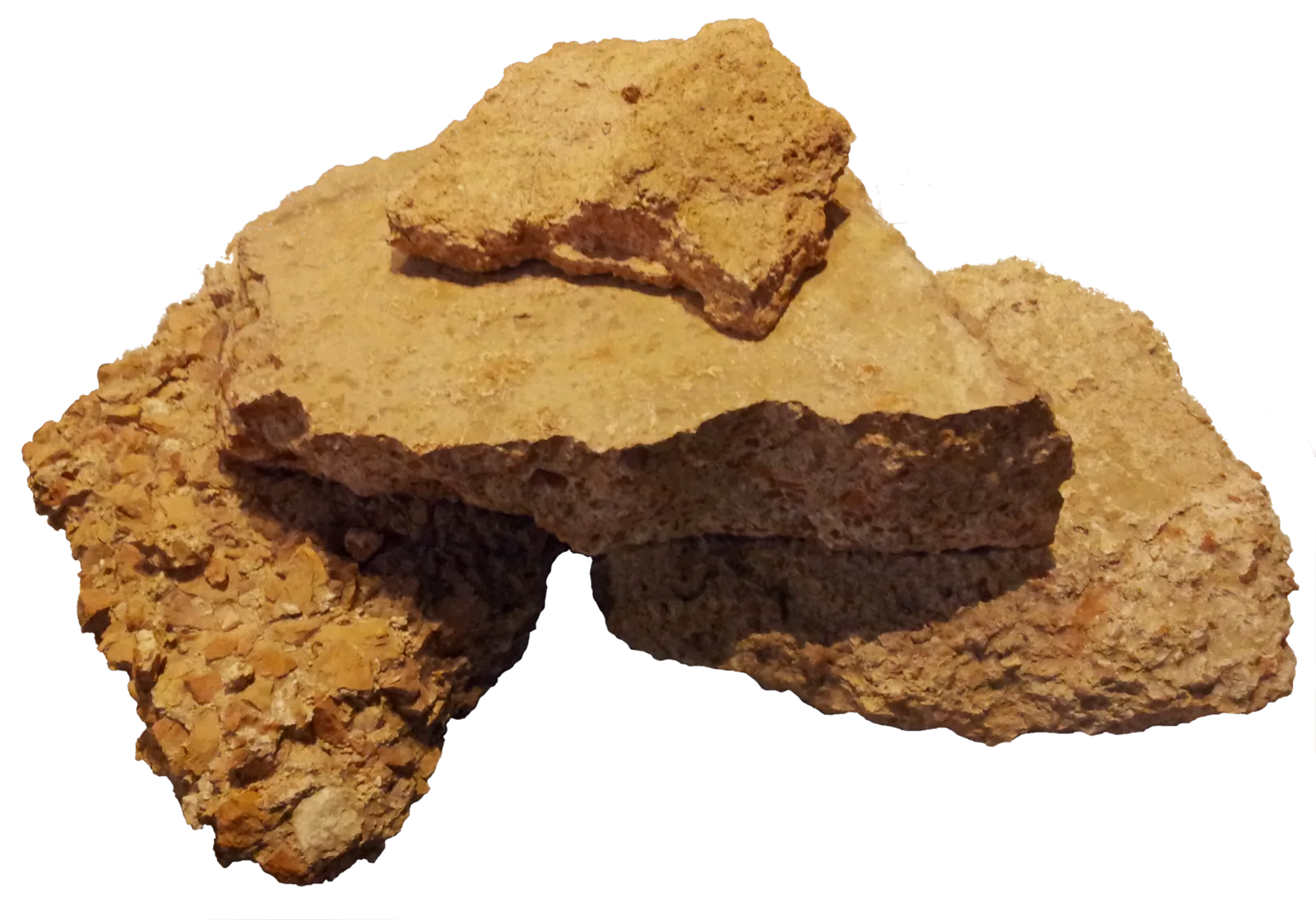
Roman concrete — opus caementicium — is a hydraulic-setting cement mixed with aggregate, and it is the reason the Pantheon still has the world's largest and oldest unreinforced concrete dome. In widespread use from about 150 BC (some scholars say a century earlier), it built bridges, reservoirs and aqueducts across the empire, structures still standing as testimony to its versatility and durability. Its famous ingredient was pozzolana, the volcanic sand of the Bay of Naples that Vitruvius recommended for structural mortars; long-held explanations credited its ash with stopping cracks from spreading. Research in 2023 rewrote the story: mixtures of different limes form conglomerate clasts inside the concrete that let cracks self-repair — the material heals itself. Roman concrete differs from its modern descendant in the workmanship too: with larger aggregate, it was laid rather than poured, and like any hydraulic concrete it set underwater, which is why Rome's harbours and riverside works could cure in place.
Key facts
- Composition: a hydraulic-setting cement mixed with aggregate — often laid, not poured, because the aggregate included larger components.
- Signature ingredient: pozzolana, the volcanic sand of the Bay of Naples beds, recommended by Vitruvius for structural mortars.
- Self-repair: recent research attributes the durability to conglomerate lime clasts that let cracks heal rather than spread.
- Survivor: the Pantheon still holds the world's largest and oldest unreinforced concrete dome.
In depth
Origins and preconditions
Roman concrete grew out of lime mortar, and its decisive ingredient was local geology: pozzolana, the brownish-yellow-gray volcanic sand of the beds near Pozzuoli — reddish-brown nearer Rome. Vitruvius, writing around 25 BC, distinguished mortars and recommended the ash for structural work; the material was in widespread use from about 150 BC, and some scholars date it a century earlier. That timing places opus caementicium inside the concrete revolution, the run of innovative developments that let Roman builders attempt structurally complicated forms no earlier tradition had managed. The recipe was pragmatic — cement plus whatever aggregate the site offered — but the volcanic sand is what turned an ordinary mortar into one that could carry domes and harbour walls.
The concrete revolution was an architectural event before it was a materials one. Once builders could lay a monolithic mass that set underwater and could be shaped while wet, the post-and-lintel grammar of Greek temples gave way to vaults, domes and free curved plans. The Pantheon, completed under Hadrian, is the type-case: a dome 43 metres across, still the largest unreinforced concrete dome in the world, made possible by graded aggregates — heavy basalt low, light pumice high — and by a coffered interior that removed weight without removing structure. The recipe was local, but the ambition it enabled was imperial.
How it worked
Like its modern equivalent, Roman concrete is cement plus aggregate, and the hydraulic setting is the trick: it cures through chemical reaction with water, so it can set underwater — indispensable for bridges, reservoirs and harbour works. Workmanship differed from today: aggregates often included large components, so the mix was laid in place rather than poured. For two centuries the standard explanation of its strength was pozzolanic ash preventing cracks from spreading; recent research overturned the emphasis — mixtures of different limes form conglomerate 'clasts' within the concrete, and these allow cracks to self-repair. The material, in other words, carries its own maintenance crew, which is why sea walls poured two thousand years ago still hold their line.
The material's behavior depends on the lime. Roman builders mixed quicklime with pozzolana and aggregate, and the lime did not merely glue: it reacted, forming calcium-aluminum-silicate hydrates that survived seawater and thermal cycling. Recent microscopy identified lime clasts — pockets of unslaked lime — inside the concrete; when a crack reaches them, water dissolves the lime and recrystallizes it in the gap, a self-healing mechanism modern Portland concrete lacks. The mix was also graded: large rubble at the core, finer material at the face, and wooden formwork removed once the mass had set. The result was a material that could be placed in thick lifts, cure under water and outlast the society that made it.
Diffusion
The material spread with Roman public works rather than as a trade good. Bridges, reservoirs and aqueducts carried opus caementicium across the empire, and many of those structures stand today — the article's own testimony to versatility and durability. Interiors were usually faced: brick, stucco, fresco or colored marble, because the concrete itself was structure, not finish. Its showcase is the Pantheon, whose dome — completed in the concrete revolution's mature phase — remains the world's largest and oldest unreinforced concrete dome. Unlike modern concrete, Roman material was rarely a builder's default everywhere; it was an imperial infrastructure technology, concentrated where the state was building at scale.
Roman concrete spread with the army and the tax roll. Harbours, bridges, baths, aqueducts and warehouses carried it toBritain, North Africa and the eastern provinces; the material was an instrument of Romanization as much as a building technique. Its afterlife is stranger: the recipe faded as the empire's large-scale building programs collapsed, and medieval builders returned to stone and lime mortar. Portland cement, patented in 1824, recreated concrete on a different chemistry and a different scale, and the twentieth century made it the world's most-used construction material. The Roman version now returns as a research subject — not to be copied, but to be learned from.
Impact and legacy
Roman concrete let builders think in vaults and domes instead of post-and-lintel: the Pantheon's unreinforced dome, aqueduct arches and harbour moles all follow from a material that could be laid in continuous mass and cure underwater. Its afterlife is equally instructive. The recipe was lost as a living practice, and modern concrete — Portland cement — developed on a different chemistry with a different weakness. The article's recent-research highlight shows the traffic reversed: engineers now study the lime-clast self-repair mechanism as a model for durable modern materials, from tidal-power structures to sea-level defences. Two millennia on, the empire's most enduring export is a materials-science lesson.
Roman concrete's impact is architectural and environmental at once. Architecturally, it made the arch, vault and dome into everyday grammar and allowed interiors — baths, basilicas, the Pantheon — that no stone beam could span. Environmentally, its durability is a rebuke to modern practice: Roman marine structures have survived two millennia of wave action, while modern reinforced concrete is often designed for a century or less, and its repair is a major source of carbon emissions. The research agenda is therefore practical — lime clasts, low-clinker mixes, self-healing — and the historical lesson is that a material can be both cheaper in energy and longer in service than the industrial default.
Timeline
- 150 BC–AD 126
The pozzolana era
Hydraulic lime mortars with volcanic sand spread from the Bay of Naples across Rome's public works; Vitruvius codifies the recipes and the Pantheon dome crowns the concrete revolution.
- 150 BCOpus caementicium in widespread use
- 25 BCVitruvius codifies pozzolana mortars
- AD 126–AD 500
Structures that outlive the empire
Bridges, reservoirs and aqueducts carry the material across the empire; the structures stand long after the building system fades in late antiquity.
- AD 126The Pantheon dome completes the concrete revolution
Afterlife
- AD 2023Research shows lime clasts let the concrete self-repair cracks
Connections
Related technologies
Related entries chosen for this kind of subject — shared context, place or period.
Sources
- Concrete — Encyclopaedia BritannicaAttribution
- PozzolanaWikipedia (EN)CC-BY-SA-4.0
- Roman concreteWikipedia (EN)CC-BY-SA-4.0
- Wikidata Q610076 — Roman concreteWikidata · structured dataCC0-1.0
Reuse this data: open dataset (GeoJSON / CSV, CC BY 4.0)