Technology · 约2000 BC – 约AD 500
Chariot
战车
Origin: Sintashta-Petrovka culture, south Urals steppe ·
Summary
The chariot is a light, open, two-wheeled vehicle with spoked wheels, drawn by two or more horses and crewed by a driver and a fighter. It emerged around the beginning of the second millennium BCE on the Eurasian steppe, where burials of the Sintashta-Petrovka culture preserve the oldest spoke-wheeled horse vehicles, and cylinder seals from Kültepe in Central Anatolia show the same design soon after. The critical invention was the spoked wheel, which turned the heavy wagon into a fast platform. From the steppe the chariot spread along two routes: south into Anatolia, Mitanni and the warring states of the Late Bronze Age Near East, and east into India and Shang China with Indo-Iranian and steppe contacts. Egyptians adopted it through the Hyksos and refined it into a mobile archery platform. At Kadesh, Hittite and Egyptian massed chariots fought the largest known chariot engagement. Cavalry eventually superseded it in war, but the vehicle survived centuries longer as a racing and ceremonial machine in the Mediterranean world.
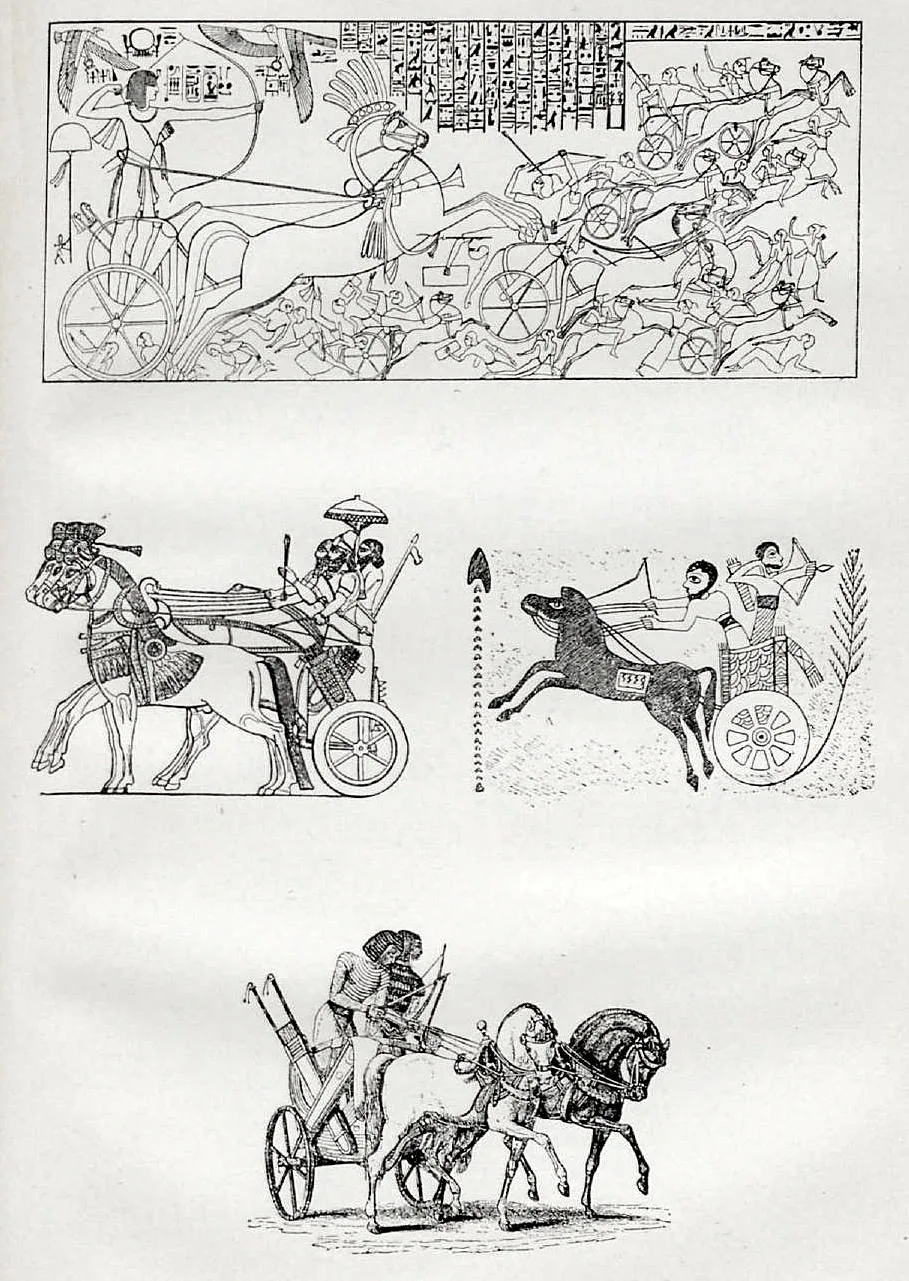
Key facts
- Design: the critical enabler was the spoked wheel, which turned the heavy solid-wheeled wagon into a light, fast vehicle.
- Crew: Egyptian chariots ran as mobile archery platforms with exactly two men — a driver with the reins and an archer with the bow.
- Capacity: Hittite designs carried three warriors on lighter four-spoked wheels placed near the vehicle's centre for balance.
- Status: before the Han period, Chinese states ranked their power by chariot counts — a thousand-chariot state was middling, a ten-thousand-chariot state a giant.
In depth
Origins and preconditions
Chariots did not appear from nothing: they condensed earlier developments in wheeled transport and horse domestication. The oldest candidates are the chariot burials of the Sintashta-Petrovka culture in the south Urals, dated around 2000-1880 BCE, though specialists Littauer and Crouwel argue the very earliest vehicles there are better classed as carts. Either way, the spoked wheel — attested on Central Anatolian cylinder seals from Kültepe around 1900 BCE — is the piece that made the light war vehicle possible. From the steppe, Indo-Iranian speakers carried both horses and the vehicle south and east. Chariot warfare's oldest Near Eastern testimony is the Old Hittite Anitta text, which mentions forty horse teams at a siege; certain attestation comes with the late seventeenth century BCE under Hattusili I.
The chariot was a system before it was a vehicle: it required horses strong enough to pull, a bit and harness that did not choke them, a spoked wheel light enough to accelerate, and a crew trained to fight from a moving platform. The Sintashta burials in the south Urals, with their paired horses, spoked wheels and weapon kits, are the earliest package; whether the first vehicles were carts or chariots is still debated, but the package is unmistakable. Its homeland was the steppe, where horses, pasture and mobility came together, and its spread was carried by the same pastoral networks that moved Indo-Iranian languages.
How it worked
A chariot is little more than a floor with a waist-high guard, light enough to be pulled at speed by two horses hitched side by side. Everything about it trades protection for speed. Egyptian vehicles carried a driver and an archer: the driver controlled the reins while the archer shot from the moving platform, with quivers mounted on the sides. Hittite designs broadened the cab for a three-man crew — driver, archer and shield-bearer — on lighter four-spoked wheels placed near the centre for balance. Harness mattered as much as the vehicle: Egyptian smiths invented the yoke-saddle around the mid-second millennium to keep the breast strap off the horse's windpipe. Driving a team in battle took trained horses and constant practice, which is why the Mitanni Kikkuli text on conditioning chariot horses survives at all.
A chariot's fighting value came from controlled speed, not from shock. The crew's job was to break formation, pursue, and shoot from a stable platform; the vehicle itself was too light to charge home like a later knight. That is why the chariot's design was dominated by weight: a floor of ash or elm, a rawhide or wicker guard, four or six spokes, and a wide track for stability. Maintenance was constant — wheels warped, harnesses stretched, horses lost condition — and the logistics of fodder and spare parts could exceed the cost of the vehicle. The chariot was a high-status weapons system whose real engine was the herd behind it.
Diffusion
The chariot moved faster than any empire. It reached the Near East in the seventeenth to sixteenth centuries BCE; Egypt acquired it through the Hyksos invasion around 1650 BCE and turned it into the arm of the New Kingdom, with the best-preserved examples from Tutankhamun's tomb. Indo-Aryan migrants introduced horses and chariots into India, where the vehicle entered epic and ritual. In China, the earliest archaeological evidence is a chariot burial at Hougang, Anyang, from the reign of King Wu Ding; the Shang used chariots mainly as command vehicles and for royal hunts, while the conquering Zhou made far more military use of them, fielding four-horse teams. By the seventh century BCE Assyria ran heavy four-crew chariots drawn by three or four horses — and their very weight pushed warfare toward cavalry.
The chariot spread faster than most technologies because it travelled with a whole social package: horses, grooms, trainers, and a warrior elite that defined itself by driving. By the Late Bronze Age, Egyptian, Hittite, Mitannian and Mycenaean courts shared a chariot culture with recognizable conventions of crew, decoration and tactics; the Amarna letters are full of requests for horses and chariots. In China the Shang used chariots for command and hunting, while the Zhou expanded them into a military arm. India's epics preserved the chariot as a royal and divine vehicle long after its battlefield role faded, and the steppe kept producing new mounted archers who would eventually outfight the chariot.
Impact and legacy
For a few centuries the chariot was the tank of its world: a fast, prestigious, expensive platform that only centralized states could field in numbers, and Kadesh — where Hittite and Egyptian chariot masses clashed around 1274 BCE — showed both its shock power and its logistical cost. Its decline is as instructive as its rise. Heavier Near Eastern designs grew costly and ponderous; infantry learned to beat charioteers; and true cavalry, riding rather than driving, outflanked a vehicle that could not turn on rough ground. China measured state power in chariots before Han times, yet by the imperial era the war chariot was memory. What survived was spectacle: in Rome and Constantinople the vehicle became a racing machine whose fan factions could shake thrones — the Nika riots of 532 began in the Hippodrome — long after no army would take one to war.
The chariot's deepest legacy is organizational. It required breeding herds, training grounds, workshops and a corps of specialists — in short, a state. That is why chariot counts became a measure of power in Shang and Zhou China, and why the Hittite and Egyptian empires invested so heavily in a weapon that could be countered by terrain and infantry. Its decline came from cavalry, which needed less infrastructure and could operate on broken ground; but the chariot's social model — an elite defined by mobility and expensive equipment — survived in the knight, the tank corps and the racing circus. The machine disappeared; the institution it created did not.
Timeline
Dates are century precision; years are century starts.
- 2000 BC–1600 BC
Steppe origins
Sintashta-Petrovka burials preserve light spoke-wheeled vehicles with horse teams. Debates continue over whether the very earliest finds are true chariots or carts, but within a few generations the design reaches Anatolia.
- 2000 BCSpoke-wheeled horse vehicles appear in Sintashta burials
- 1600 BC–1200 BC
Late Bronze Age warfare
The chariot becomes the prestige weapon of the Near East: Hittite three-man crews, Mitanni horse-training manuals, Hyksos-borne chariots in Egypt, and massed engagements such as Kadesh.
- 1600 BCHittite and Mitanni chancelleries adopt the chariot in the Near East
- 1274 BCHittite and Egyptian chariot masses clash at Kadesh
- 1200 BC–300 BC
Empires and the cavalry turn
Assyria fields heavier four-crew vehicles; Persia experiments with scythed chariots; Zhou China measures state power in chariot counts — and everywhere cavalry begins to replace them.
- 300 BC–AD 500
Ceremonial survival
In the Mediterranean the chariot leaves the battlefield for the circus: triumphal processions, imperial iconography and the faction-packed races of Rome and Constantinople.
- 200 BCCavalry supersedes the chariot as the decisive mounted arm
Afterlife
- AD 532Chariot racing still fills the Hippodrome at the Nika riots' height
Connections
Related technologies
Related entries chosen for this kind of subject — shared context, place or period.
Sources
- Chariot — Encyclopaedia BritannicaAttribution
- ChariotWikipedia (EN)CC-BY-SA-4.0
- Sintashta cultureWikipedia (EN)CC-BY-SA-4.0
- Wikidata Q203788 — ChariotWikidata · structured dataCC0-1.0
Reuse this data: open dataset (GeoJSON / CSV, CC BY 4.0)