Technology · 约3500 BC – present
Wheel
轮子
Origin: Mesopotamia and Eastern Europe (near-simultaneous) ·
Summary
The wheel is a rotating component that turns on an axle bearing, and together with the axle it is one of the six simple machines: it replaces sliding friction with rolling, letting people move loads that muscle alone could not shift. Its invention is genuinely hard to pin down because it happened more than once — pictographs of wheeled wagons appear at Uruk around the mid-fourth millennium BCE, the Bronocice pot in Poland shows a wheeled vehicle in the same centuries, and the oldest surviving wheel-and-axle, from the Ljubljana Marshes, is of similar age. Early wheels were solid wooden disks; the spoked wheel of the Sintashta culture turned the wagon into the fast chariot. China received wheeled transport from the west; the Americas made wheeled toys but no working carts, blocked less by ignorance than by the absence of a domesticable draft animal. Beyond transport the wheel became a machine element — water wheels, cogwheels, spinning wheels, turbines — and the wire-spoked wheel and pneumatic tire of the late nineteenth century reinvented it once more.
Key facts
- Mechanics: a wheel-and-axle replaces sliding friction with rolling — one of the six simple machines, driven by gravity, force or torque about its axis.
- Two designs: early European wheel-and-axle pairs differ on whether the wheel turns with the axle or the axle stays fixed in the vehicle.
- The Americas: wheeled toys appear at Mexican sites, but without a domesticable draft animal the practical cart never follows.
- Descendants: the water wheel, cogwheel, spinning wheel, turbine and propeller are all wheel logic applied to work rather than travel.
In depth
Origins and preconditions
The wheel evolved from rollers — round logs under heavy slabs — and its invention had to wait for the late Neolithic, several wheel-less millennia after agriculture and pottery. When it came, it came more than once. Uruk's clay tablets picture wheeled wagons around 3500–3350 BCE; the Bronocice pot in southern Poland, dated between 3631 and 3380 BCE, carries what may be the oldest drawn vehicle; the Ljubljana Marshes wheel and axle is dated 3340–3030 BCE; finds cluster across the northern Caucasus and Eastern Europe in the same centuries. A potter's wheel from Cucuteni–Trypillia Ukraine actually predates the Ur example once thought oldest. Some historians read a diffusion from the Near East; others see parallel invention. Either way, the wheel's birthplace is a band of country, not a single village.
The wheel is less an invention than a package: a rotating disc needs a fixed axle, a bearing, a draught animal and a load worth moving. That is why it appeared where agriculture had already produced surpluses, where cattle and donkeys could be yoked, and where copper tools could shape hardwood. It also explains the exceptions: the Andes and Mesoamerica had the wheel as a toy but no animal that could pull a cart, while Egypt adopted the wheel late and relied on the Nile barge for bulk transport. The earliest wagons were slow, wide-tracked and expensive, symbols of elite power as much as farm equipment.
How it worked
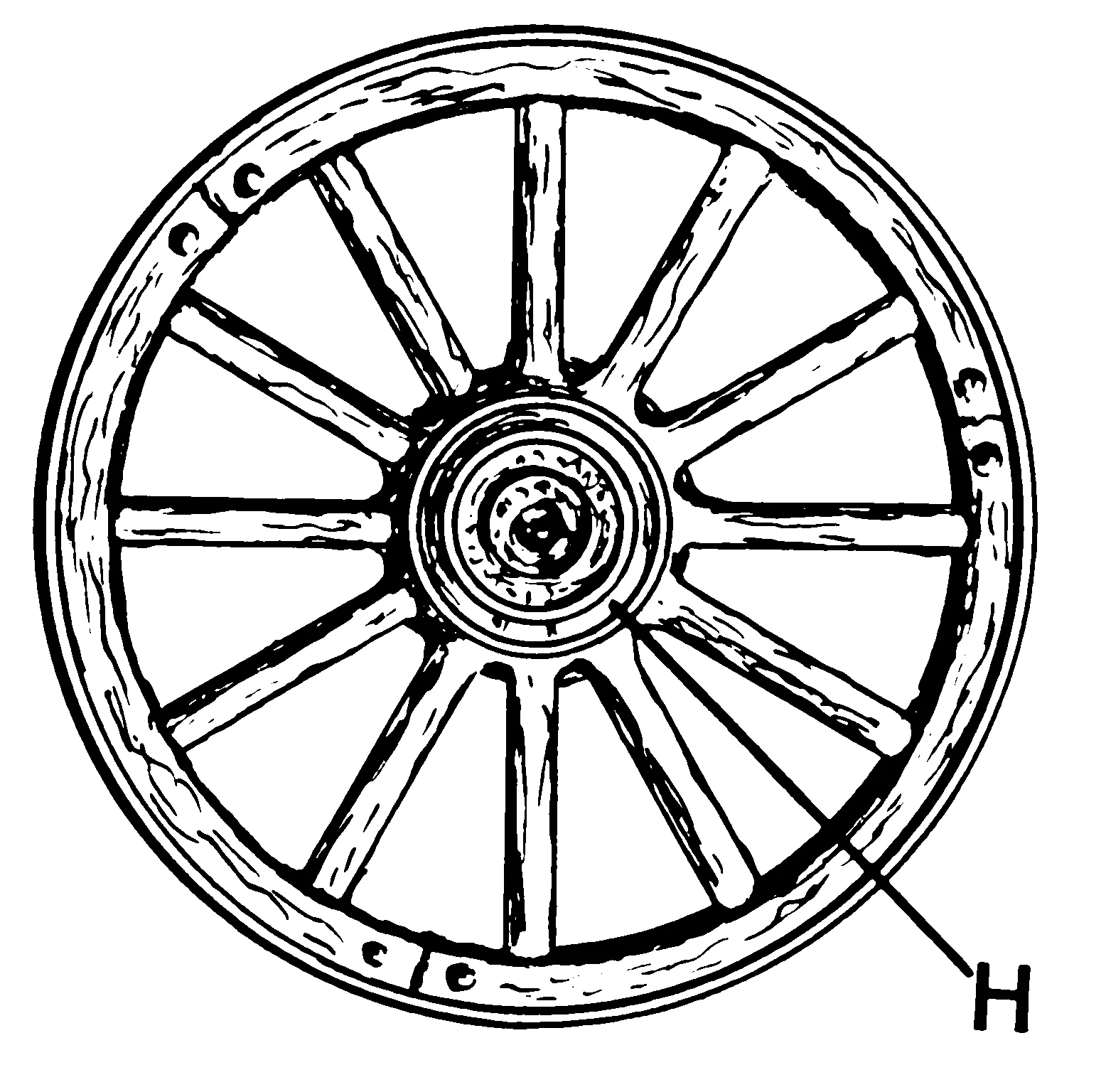
A wheel works by turning rolling contact into low friction, but the wheel alone does nothing — the axle does half the work, and how the two are joined decides everything. Early wheels were horizontal slices of tree trunk, weak because wood grain runs lengthwise; better wheels were assembled from curved longitudinal boards. The two early European constructions differ tellingly: in the circumalpine type the wheel and axle rotate together, in the Baden type the axle stays fixed in the vehicle. The decisive upgrade was spokes — removing mass from the rim's path and letting the rim carry tension rather than dead weight. Wood grain, spoke count and hub fit were the whole engineering problem, which is why the spoked wheel, once it arrived at Sintashta, changed warfare more than any single stone tool ever had.
The wheel's physics is simple and unforgiving: rolling resistance falls with a larger radius and a harder, smoother rim, while the axle must carry the load without seizing. Early wheels were slices of trunk with the grain running across the tread, which wore and split; later wheels were built like barrels from longitudinal boards, and the spoked wheel turned the rim into a tension ring. Bearings were the quiet bottleneck — leather, wood and bronze bushes had to be greased and replaced — and the whole vehicle had to be light enough for one or two animals yet strong enough for a loaded bed. Every gain came from trading mass in the wrong place for strength in the right one.
Diffusion
The wheel's spread followed horses and roads. From the steppe, the spoked wheel rode the chariot into the Near East, India and Shang China; wheel tracks at Pingliangtai date to around 2200 BCE and spoked hubs in Qinghai to the early second millennium, consistent with vehicles 'introduced to China from the west'. The Americas are the great counterexample: Mexican sites yield wheeled toys from about 1500 BCE, yet Mesoamerica never built the cart — the llama, the one domesticated large animal, could not pull one. Nubians after about 400 BCE used wheels to spin pottery and raise water, and much of sub-Saharan Africa kept wheeled transport marginal until the nineteenth century. In the industrial West the wheel was redesigned again: wire spokes under tension and pneumatic tires cut rolling resistance and comfort-proofed the ride.
Diffusion was uneven because the wheel only pays where roads and loads exist. The steppe chariot carried the spoked wheel from the Urals to China and India; Rome's road network made wheeled transport routine in the Mediterranean, while the Alps and the Sahara long favoured pack animals. China illustrates the conditional case: wheeled carts existed from the Shang, yet the canal and the sedan chair often beat the cart for bulk and passenger transport, and the wheel's military form arrived later than its domestic form. In the modern world the wheel's diffusion is nearly total, but its shape is still local: rail flanges, bicycle spokes, truck tyres and turbine blades are all answers to different loads and surfaces.
Impact and legacy
The wheel's deepest impact came from places wheels never roll. As a machine element it powered the pre-industrial economy: water wheels and norias lifted irrigation water, cogwheels transmitted power in mills and the Antikythera mechanism, spinning wheels multiplied textile output. As transport it demanded roads, bridges and harnesses — the wagon's load, not the wheel's rim, decided which states could move grain and armies. Its absence is as instructive as its presence: the Americas kept the wheel a toy, Australia a target disc, and much of Africa a ceremonial oddity, because wheels pay only where draft animals, roads and loads align. And when the wheel finally met the engine, the pair — railway flanged wheels, wire-spoked bicycles, pneumatic tires — carried the industrial world's traffic, making this the rare invention whose second act outgrew its first.
The wheel's economic impact is measured in what it replaced: human backs and animal loads. A cart pulled by one horse can move several times the weight a porter can carry, which changes the price of grain, the size of markets and the reach of armies. The wheel also became the model for a whole class of machines — the potter's wheel, the waterwheel, the cogwheel, the pulley — and rotary motion became the organizing principle of industrial production. Its absence is equally telling: societies without draft animals or roads did not fail to invent the wheel; they rationally declined to use it where it could not pay.
Timeline
Dates are century precision; years are century starts.
- 3500 BC–2000 BC
Potter's wheels and solid disks
Pictographs, toy carts and track ruts multiply across Mesopotamia, Europe and the Caucasus. Early wheels are heavy slices of tree trunk; two axle traditions emerge in Europe — wheel and axle turning together, or fixed axle.
- 3500 BCWheeled wagons appear in Uruk pictographs and across Eurasia
- 3200 BCThe Ljubljana Marshes wheel-and-axle survives as the oldest known combination
- 2000 BC–300 BC
Spokes, chariots and iron rims
The spoked wheel makes vehicles light and swift; horse cultures of the Caucasus run chariots across the Near East, India and China. Celtic smiths later rim wheels with iron.
- 2000 BCSpoked wheels at Sintashta enable the chariot
- 300 BC–AD 1880
From road to machine
Wheels power things that do not move: water wheels, cogwheels, spinning wheels, turbines. The Americas and much of Africa stay wheel-light, and the industrial age reinvents the wheel with wire spokes and pneumatic tires.
- 300 BCNubian water wheels put the wheel to work
- AD 1880Wire-spoked wheels and pneumatic tires reinvent rolling
The last phase ends at its data cut-off; the entity window remains open to the present.
Connections
Related technologies
Related entries chosen for this kind of subject — shared context, place or period.
Sources
- Wheel — Encyclopaedia BritannicaAttribution
- Ljubljana Marshes WheelWikipedia (EN)CC-BY-SA-4.0
- WheelWikipedia (EN)CC-BY-SA-4.0
- Wikidata Q446 — WheelWikidata · structured dataCC0-1.0
Reuse this data: open dataset (GeoJSON / CSV, CC BY 4.0)