Technology · 105 – present
Papermaking
造纸术
Origin: Luoyang, Han China ·
Summary
Papermaking is the process of turning plant fibre into flat, strong sheets by draining a dilute fibre suspension through a screen, then pressing and drying the mat. The method matured at the Han court: hemp wrapping paper had existed in China for centuries, a sheet bearing legible writing is dated to the last decades of the Western Han, and the traditional attribution runs to the court official Cai Lun, credited with a fibre blend of mulberry bark, fishnets, old rags and hemp waste. Paper became the everyday writing medium of East Asia, then crossed into the Islamic world in the eighth century, where thicker sheets and water-powered pulp mills turned a court craft into bulk industry, from Samarkand and Baghdad to Damascus, Cairo and Muslim Spain. Europe adopted the mould-and-watermark technology through Italy, and it was printing that finally made paper indispensable: mills multiplied to feed movable type, the Song had already printed the first paper money, and industrial machines and wood pulp eventually carried paper into every office and newsstand.
Key facts
- Furnish: Cai Lun's recipe pulped mulberry bark with fishnets, old rags and hemp waste — recycled fibre rather than fresh timber.
- Form: a dilute fibre suspension drains through a stretched screen; couching, pressing and drying leave a mat of randomly interwoven cellulose.
- Industry: Islamic papermakers thickened the sheet and harnessed water-powered pulp mills, converting a court craft into bulk production.
- Uses: the Song government issued the first paper-printed money, and Tang makers were already folding and sewing paper tea bags.
In depth
Origins and preconditions
Paper did not appear from nothing, and its nearest Mediterranean rival was never paper at all: papyrus sheets were pressed from strips of Cyperus papyrus pith in Egypt, strong but prone to separating along the strips when rolled. In China, hemp paper had served as wrapping and padding since the eighth century BCE, and a sheet carrying legible Chinese writing is dated to the last years of the Western Han. The decisive step is traditionally credited to Cai Lun, an official attached to the Han court, whose process of about 105 CE pulped mulberry and other bast fibres with fishnets, old rags and hemp waste — cheap, recycled inputs that could be produced in quantity. The old media it displaced, inscribed bamboo slips and silk, were respectively bulky and expensive; paper was neither.
Paper's victory was economic before it was technical. Bamboo slips were heavy, silk was costly, and papyrus had to be imported from Egypt and split along its strips; paper could be made from rags, hemp, mulberry bark and fishing nets that were otherwise waste. That recycled feedstock is the key: paper turned garbage into a writing surface, and the Fangmatan map, buried in Gansu in the second century BCE, shows the material existed before Cai Lun's famous improvement. Cai Lun's contribution was less a first invention than a standardization of pulping, sizing and sheet-forming that made paper reliable enough for administration.
How it worked
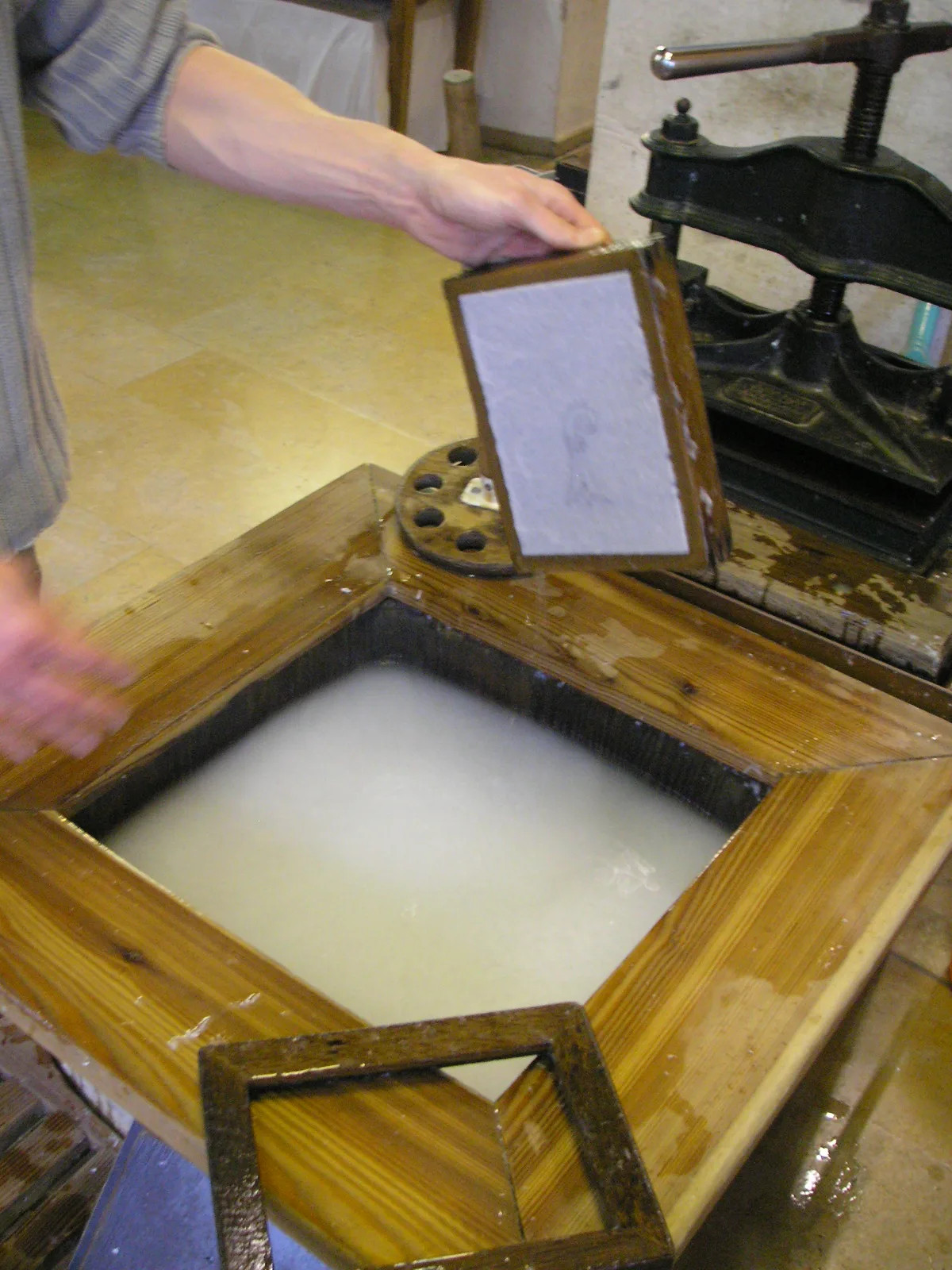
The core of the craft is simple and has hardly changed: fibres are separated, beaten into pulp, and suspended in water as 'furnish'. A mould — a wooden frame holding a stretched screen — is dipped into the suspension and lifted, leaving a mat of randomly interwoven fibres on the screen. The wet sheet is couched onto felt, stacked, pressed, and dried. The screen's wires leave 'laid' and 'chain' lines, and a woven design in the wire leaves a watermark visible against the light. Fibre choice decides the sheet: long inner-bark fibres such as kōzo give strong translucent East Asian papers, rag fibre built European stock, and the Islamic innovation of sizing and thicker sheets made the surface pen-friendly. Deckle edges, laid lines and watermarks remain the fingerprints of hand papermaking today.
Papermaking is a controlled collapse of fibre suspension. The pulp is beaten until the fibres fray and bond; the mould lifts a thin mat; pressing and drying lock the sheet without glue. Sizing — starch in the East, animal glue in Europe — decides whether ink sits on the surface or feathers into the fibre, which is why paper and pen evolved together. Fibre length sets strength, and the addition of bark or rag changes colour and absorbency. Hand papermaking is thus a set of small decisions — beating time, fibre mix, sheet weight, drying — that a modern machine reproduces at speed but not always with the same control.
Diffusion
Paper crossed into the Islamic world in the eighth century and was transformed there. Production began in Samarkand, where the earliest water-powered pulp mills appear, then Baghdad under the vizier Ja'far ibn Yahya, then Damascus — first noted by Arabic geographers in the ninth century — Cairo, Morocco and Muslim Spain. Islamic makers invented a thicker sheet that suited pens, and the machinery for bulk manufacturing: the innovation, as the sources put it, helped transform papermaking from an art into a major industry. Europe lagged for centuries because parchment still served, but metallic-wire moulds and watermarks were well established by 1300, and when movable-type printing arrived the demand curve broke upward — many new mills entered production to feed it.
Papermaking's westward route is a story of craftsmen as much as materials. Tradition places the transfer at the Battle of Talas in 751, when captured Chinese papermakers were said to have taught the craft in Samarkand; whatever the truth of that story, Samarkand had paper by the eighth century, Baghdad by 793, and Damascus, Cairo and Fez followed. Europe's first mill appears in Spain in the eleventh century, and the craft reached Italy by the thirteenth. Printing then changed the scale: a press could consume more paper in a month than a scriptorium in a year, and mills multiplied along European rivers. The knowledge travelled; the rags, water and skill had to be local.
Impact and legacy
Paper collapsed the cost of information. In East Asia it carried administration, Buddhist copying projects and, under the Song, the first government paper-printed money — paper as value, not just as text. In the Islamic world it underwrote the bookshops and libraries of Baghdad. In Europe it made printing economical: without cheap rag paper, movable type would have been a curiosity instead of a revolution. Industrialization then industrialized paper itself — the Fourdrinier machine cast the sheet as a continuous roll, and in the 1840s Charles Fenerty and Friedrich Gottlob Keller showed that wood pulp could replace rags, ending a two-thousand-year fibre tradition and opening the era of cheap newsprint. The cost is environmental: harsh chemicals, water use and fibre sourcing remain the trade's standing problems.
Paper's deepest effect was to make writing cheap enough to be ordinary. It carried tax registers, Buddhist sutras, government gazettes and, from the Song, paper money; in Europe it carried the printing press, the Reformation pamphlet and the scientific journal. The industrial machine — the Fourdrinier in 1807, wood pulp in the 1840s — turned paper from a craft into a commodity, and the twentieth century added packaging, newsprint and office reams. The bill arrived later: pulp mills are among the most water- and energy-intensive industries, and paper recycling is now as much an environmental strategy as an economic one. A material invented for administration became the substrate of modern public life.
Timeline
- 105–750
Court invention, empire-wide use
The improved process spreads through the Chinese empire; paper displaces wood slips for documents and reaches everyday uses from tea packaging to toilet paper by the sixth century.
- 105Cai Lun's fibre-blend process reaches the Han court
- 750–1250
The Islamic paper industry
Thicker sheets and water-powered pulp mills convert a court craft into bulk production, from Samarkand and Baghdad to Damascus, Cairo, Morocco and Muslim Spain.
- 750Paper mills begin working in the Islamic world at Samarkand
- 1250–1450
European mills and watermarks
Metallic-wire moulds and watermarks are established by 1300; hemp and linen rags remain the pulp, and paper still competes with papyrus and parchment.
- 1450–1844
Printing, machines and wood pulp
Movable type makes paper indispensable and mills multiply; the Fourdrinier machine produces continuous rolls, and Fenerty and Keller's wood-pulp process closes the rag era.
- 1450Movable-type printing drives a boom in paper mills
- 1844Wood-pulp processes open the era of cheap newsprint
The last phase ends at its data cut-off; the entity window remains open to the present.
Connections
Used by
Showing the 10 earliest adopters by the adopter's start date (of 25).
Contributed to
Related technologies
Related entries chosen for this kind of subject — shared context, place or period.
Sources
- Papermaking — Encyclopaedia BritannicaAttribution
- History of paperWikipedia (EN)CC-BY-SA-4.0
- PapermakingWikipedia (EN)CC-BY-SA-4.0
- Wikidata Q335415 — PapermakingWikidata · structured dataCC0-1.0
Reuse this data: open dataset (GeoJSON / CSV, CC BY 4.0)