Technology · 1895 – present
Radio
无线电
Origin: Italy (Marconi's first practical system) ·
Summary
Radio is communication by radio waves — electromagnetic oscillations from a few hertz to hundreds of gigahertz, generated by a transmitter, radiated from an antenna, and picked up by a receiver. Its theory chain is clean: Maxwell predicted electromagnetic waves in 1873; Heinrich Hertz proved they exist with a spark-gap transmitter in 1886; and in the mid-1890s Guglielmo Marconi turned physics into a system, sending Morse code without wires — first over a kilometre in 1895, then, on 12 December 1901, across the Atlantic. Early radio was wireless telegraphy, the telegraph's heir without its wires; broadcasting arrived when transmitting got cheap enough to point one signal at everyone, and the first commercial broadcast — the 1920 US presidential election returns from Pittsburgh's KDKA — created mass listening. Radio became the century's hearth: news, entertainment, war reporting, navigation, radar, and now the invisible carrier inside phones, Wi-Fi and satellites, all modulating the same waves. Broadcasting then made radio the mass medium, and solid-state electronics turned it into the invisible carrier of phones, Wi-Fi and satellites.
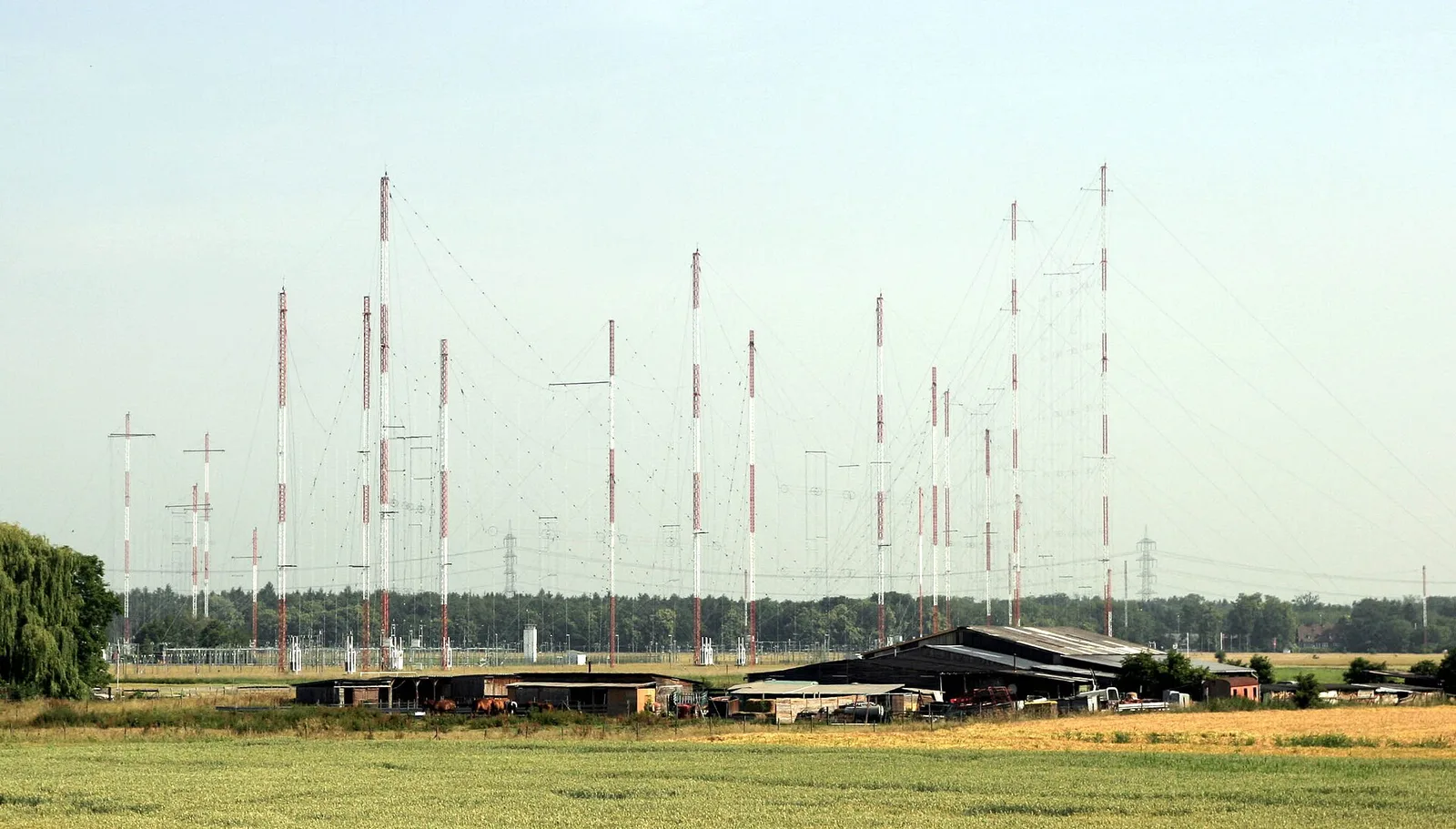
Key facts
- Wave range: radio waves span from a few hertz to 300 GHz, carrying everything from time signals to satellite links.
- Theory chain: Maxwell predicted the waves in 1873; Hertz demonstrated them in 1886 with a spark-gap transmitter.
- Broadcast first: the first commercial broadcast carried the live returns of a US presidential election from Pittsburgh under the call sign KDKA.
- Modulation: information rides on the wave by varying amplitude or frequency; bandwidth, not location, sets how much a channel can carry.
In depth
Origins and preconditions
Radio began as a prediction. James Clerk Maxwell's 1873 theory of electromagnetism proposed that coupled electric and magnetic fields could travel through space as waves — and that light itself was one, differing only in frequency. Heinrich Hertz, trying to confirm the theory, generated and detected radio waves with a primitive spark-gap transmitter in 1886; experiments by Hertz, Jagadish Chandra Bose, Oliver Lodge and others showed these waves reflect, refract, diffract and polarize like light, at the same speed. What physics proved, engineering then systematized: building on the techniques physicists used to study electromagnetic waves, Guglielmo Marconi developed in the mid-1890s the first apparatus for long-distance radio communication, sending a wireless Morse message over a kilometre in 1895. Radio communication was first called wireless telegraphy — the telegraph, unmoored.
Radio's origin is a rare case of theory preceding hardware by decades. Maxwell's equations predicted electromagnetic waves in 1873; Hertz generated and detected them in 1886; Marconi turned the laboratory demonstration into a communication system in the mid-1890s. The intermediate step was conceptual: if waves can be generated at will and detected at a distance, they can carry information by being switched on and off — wireless telegraphy. The physics was universal, which is why many inventors converged on the same devices, and why the patent battles that followed were as much about priority as about principle.
How it worked
Radio's working core is modulation: a carrier wave oscillates at a chosen frequency, and the information signal varies some aspect of it — amplitude for AM, frequency for FM — so the wave carries a message. Transmitters generate and amplify the wave; antennas radiate it into space; receivers pick up a mixture of every signal arriving and use tuned circuits — resonators that answer only their chosen frequency — to select the one station and reject the rest. Every transmitter owns its frequency, which is why many stations share the air without colliding. Bandwidth is the currency: a television signal needs more than a voice, satellites more still, and the spectral-efficiency tricks of digital modulation now squeeze more information per hertz than the pioneers dreamed.
Radio works by modulation and selection. A transmitter generates a carrier at a chosen frequency and varies it with the message — amplitude, frequency or phase — so the receiver can recover the signal. The receiver's antenna picks up every transmission in range, and tuned circuits select the wanted frequency while rejecting the rest; this selectivity is what allows thousands of stations to share the spectrum. Bandwidth is the limiting resource: a voice channel needs a few kilohertz, television megahertz, and digital systems use compression and coding to pack more bits into each hertz. The whole system is a compromise between range, power, bandwidth and noise.
Diffusion
Radio scaled in two directions at once. Outward: Marconi's transatlantic signal of December 1901 joined continents, ships went to sea with wireless telegraphy, and the 1909 Nobel Prize in Physics — shared with Karl Ferdinand Braun — marked the system's arrival. Then inward, to everyone: on 2 November 1920, Westinghouse's Pittsburgh station KDKA broadcast the live returns of the US presidential election, the first commercial radio broadcast — and mass listening began. The medium proliferated into television's picture, radar's reflected pulses, radio navigation for ships and aircraft, and two-way services. By the century's end, digital modulation had quietly turned radio into the carrier of cellular phones, Wi-Fi and satellite links — the same waves, carrying networks.
Radio spread from ships to homes to pockets. Marconi's transatlantic signal in 1901 proved intercontinental reach; ships adopted wireless for safety; the first commercial broadcast, KDKA in 1920, turned the medium into mass culture. Television added pictures, radar added reflection, and navigation systems added position. After the Second World War, radio's centre of gravity moved from broadcasting to two-way services: walkie-talkies, cellular phones, Wi-Fi, Bluetooth and satellite links. The same physics that carried Morse carries the internet's last mile, which is why radio is now less a medium than the ambient layer in which other media travel.
Impact and legacy
Radio collapsed distance for everyone, not just for companies. The telegraph had moved text between offices; broadcasting moved voices into kitchens and fields, creating the first shared national conversations — elections, wars, weather, serials — heard simultaneously by millions. At sea, wireless telegraphy rescued ships; in the air, radio navigation and radar redrew both flight and warfare; on the spectrum, regulation became a permanent international concern because airwaves are shared by nature. Its second life may be larger than its first: every mobile phone, Wi-Fi router and satellite link is a radio at heart, and the 'wireless' world is now so saturated that the waves Hertz proved are simply the medium in which modern life transmits.
Radio collapsed distance for everyone, not just for companies. Broadcasting created the first simultaneous national audiences — elections, wars, weather, music — and made the human voice a mass medium. At sea and in the air, radio navigation and radar redrew safety and warfare; on land, two-way radio organized dispatch, emergency services and, eventually, the mobile phone. Spectrum became a governed commons, with international conferences allocating frequencies like territory. The internet's wireless tail — Wi-Fi, cellular, satellite — is radio's second act, and it is larger than the first: the waves Hertz proved are now the medium in which daily life transmits itself.
Timeline
- 1895–1901
From prediction to proof
Maxwell's theory and Hertz's experiments establish the waves; Marconi engineers them into a communication system and crosses the Atlantic.
- 1895Marconi's first practical wireless transmission
- 1901–1920
Wireless telegraphy era
Ships, empires and news services run on spark and Morse; the Nobel Prize honors Marconi and Braun; regulation begins to sort the spectrum.
- 1901The first transatlantic radio signal
- 1909Marconi and Braun share the Nobel Prize in Physics
- 1920–1990
Broadcast and beyond
One transmitter, many listeners: broadcasting makes radio the mass medium; radar and navigation extend it; solid-state electronics miniaturize it.
- 1920KDKA broadcasts the first commercial radio program
- 1990Digital modulation makes radio the carrier of networks
The last phase ends at its data cut-off; the entity window remains open to the present.
Connections
Influenced by
Technologies used
Related technologies
Related entries chosen for this kind of subject — shared context, place or period.
Sources
- Radio technology — Encyclopaedia BritannicaAttribution
- Guglielmo MarconiWikipedia (EN)CC-BY-SA-4.0
- RadioWikipedia (EN)CC-BY-SA-4.0
- Wikidata Q872 — RadioWikidata · structured dataCC0-1.0
Reuse this data: open dataset (GeoJSON / CSV, CC BY 4.0)