Technology · 约3300 BC – 约AD 100
Cuneiform
楔形文字
Origin: Uruk, southern Mesopotamia ·
Summary
Cuneiform is the earliest known writing system, developed in southern Mesopotamia to record the accounting of a temple economy and then adapted to write a dozen languages across the ancient Near East.
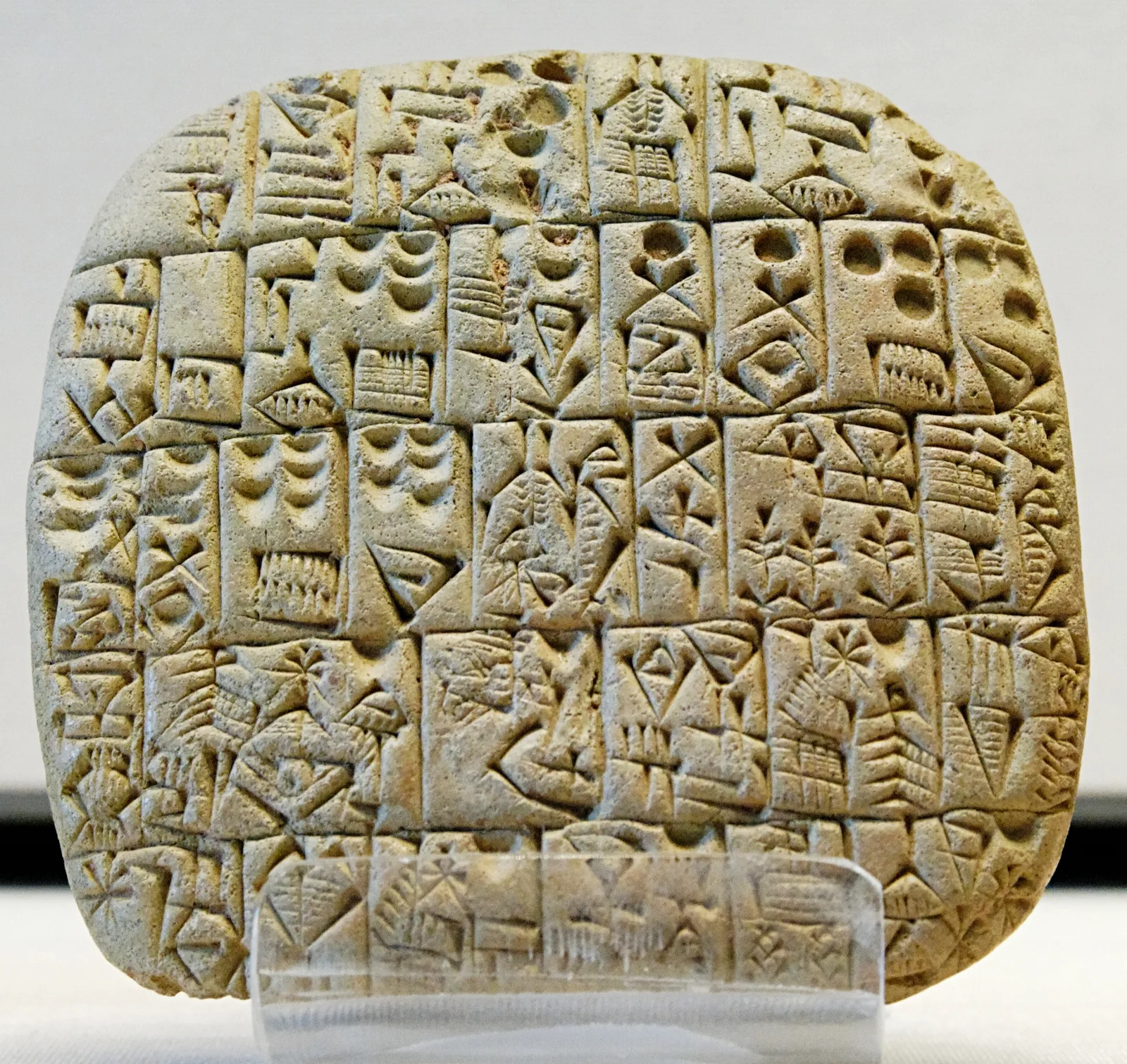
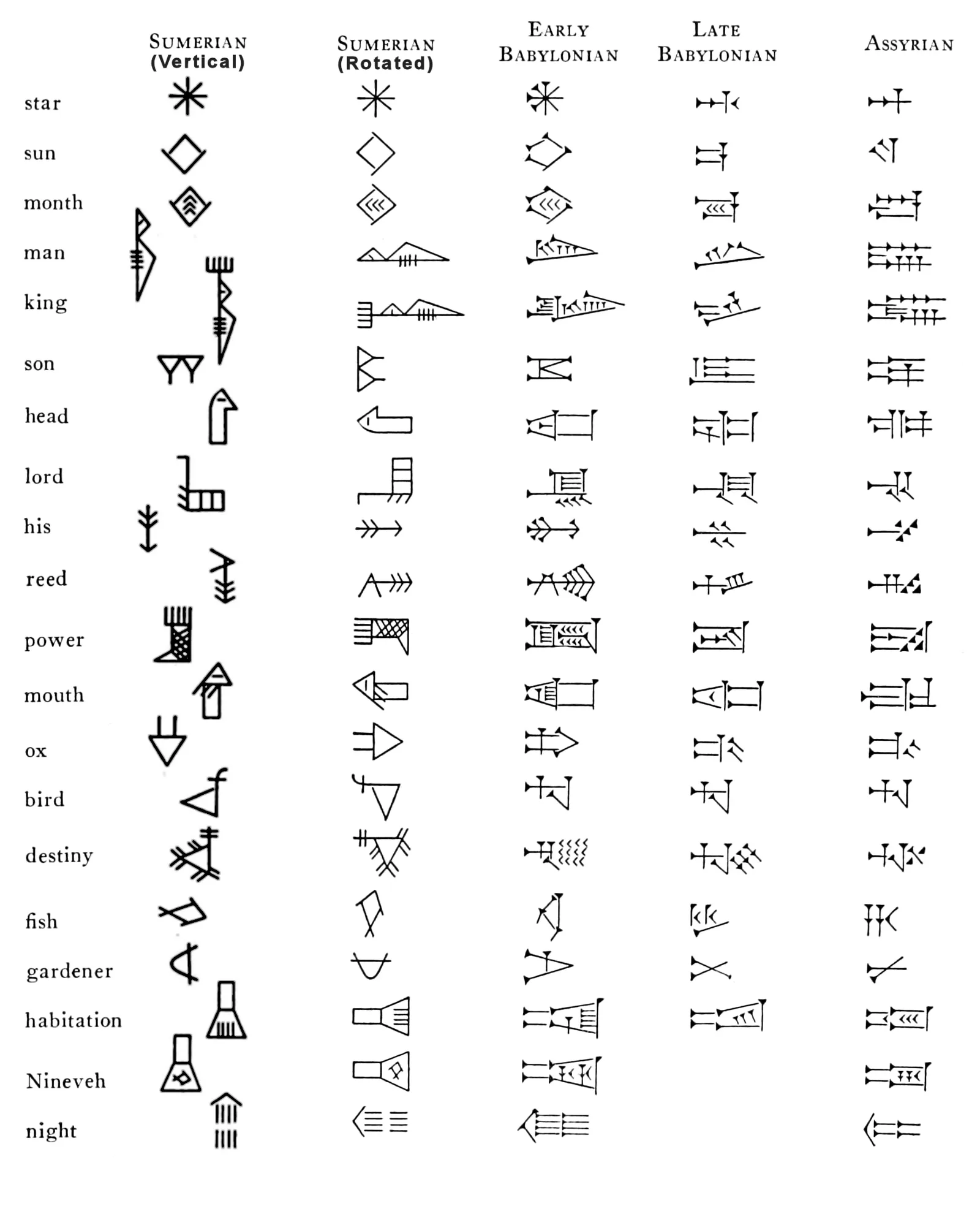
Its signs began as pictographs pressed into clay with a reed stylus; over centuries they became abstract wedges that could stand for syllables as well as words. The script served Sumerian, Akkadian, Hittite, Elamite, Hurrian and Old Persian, and it carried laws, letters, contracts, omens and literature — most surviving tablets, however, are routine administration. Cuneiform remained in use for more than three thousand years before alphabetic writing displaced it in the Roman era. The last firmly dated tablet belongs to the first century AD, and the script was only recovered in the nineteenth century, when scholars deciphered the trilingual royal inscriptions of Persepolis. Half a million tablets now sit in museum collections, still largely unpublished. Its decipherment turned a lost civilization into a readable archive of laws, letters and accounts.
Key facts
- Sign inventory: the late standard sign list ran to roughly 600 signs; earlier pictographic inventories were larger.
- Language reach: the same sign tradition was adapted by more than a dozen languages, including Sumerian, Akkadian, Hittite, Elamite and Old Persian.
- Carrier: administrative and legal documents make up the overwhelming majority of surviving tablets; royal-library literature is the celebrated exception.
- Survival: museums hold roughly half a million tablets, most still unpublished.
In depth
Origins and preconditions
Writing grew out of accounting. In late fourth-millennium Uruk, temple administrators sealed small clay tokens inside hollow balls and impressed the contents on the outside; flat tablets with the same marks followed. The earliest signs were pictures of grain, cattle, fish and jars, combined with numerals. Because the system recorded quantities and names rather than continuous speech, it is usually called proto-cuneiform. Its users were a narrow literate class attached to temples and palaces, and the archive was a tool of management before it became a medium of narrative.
Whether writing was invented for accounting or for language is still argued, and cuneiform sits at the centre of the argument. The token-and-bulla system could record quantities but not speech; the leap to signs standing for words and syllables turned a ledger into a script. That leap happened in the same Uruk world that was building the first cities, and it is hard to separate the two: writing was one of the technologies that made a city administrable. The earliest tablets are not literature but rations, land and labour — and the scribal school, the edubba, grew up to reproduce the skill.
How it worked
A scribe held a cut reed at an angle and pressed it into wet clay, producing the wedge-shaped head that gives cuneiform its name. Signs could be read as whole words (logograms), as syllables, or as classifiers that told the reader what kind of noun followed. The inventory shrank from roughly fifteen hundred pictographs to about six hundred signs as writing became more phonological, and scribes used determinatives to resolve ambiguity. Tablets were dried or, for durable documents, fired; colophons sometimes name the scribe, the owner and the occasion. The system was flexible enough to write unrelated languages, which is why it outlived Sumerian as a spoken tongue.
Cuneiform was shaped by its material as much as by its grammar. Wet clay accepts a reed stylus at an angle, and the resulting wedge is faster to press than to draw, which pushed the script away from pictures and toward abstract strokes. Tablets were small, curved and often reused; important documents were enclosed in clay envelopes or fired, and the envelope could carry a seal impression. Scribal training was long and conservative, copying sign lists and model contracts, which is why the tradition preserved archaic signs long after their sounds had changed. The medium, in other words, selected for a script that could be taught and copied.
 Open original
Diffusion
Cuneiform spread with scribal training, not conquest. Ebla in Syria kept archives in the same tradition; Akkadian scribes adapted the signs to a Semitic language and made Akkadian the bulk of the surviving corpus; Hittite chancelleries in Anatolia borrowed the system in the early second millennium. Elam, Hurrian and Urartu each developed local sign inventories, and the Achaemenid kings carved Old Persian in a deliberately simplified cuneiform for display. Every adaptation kept the wedge and the clay tablet while changing the sign values, a reminder that the technology travelled as a set of practices rather than a fixed code.
Cuneiform's diffusion is best read through archives. The Amarna letters, found in Egypt, contain correspondence from Babylonia, Assyria, Mitanni and the Levantine vassals, all written in Akkadian cuneiform — the diplomatic lingua franca of the fourteenth century BCE. Hittite scribes adapted the signs to an Indo-European language, and Ugarit developed an alphabetic cuneiform beside the syllabic one. The script's reach shows that writing could travel without the language that invented it. Its modern diffusion is scholarly: the Behistun inscription's trilingual text let Rawlinson and others crack the code in the nineteenth century, and today's digital corpora put half a million tablets online.
Impact and legacy
Cuneiform made the state legible: taxes, rations, land, labour and debt could be fixed in clay and checked later. It also preserved the first law codes, the first epic, the first astronomical records and a diplomatic archive in which great kings addressed one another as brothers. Its loss was gradual; alphabetic scripts were cheaper to learn and better suited to Aramaic, the lingua franca of the Persian Empire. The script survived only as a scholarly memory until the nineteenth century, when the trilingual inscriptions at Persepolis allowed decipherment. Assyriology was born from that recovery, and half a million excavated tablets still await full publication.
Cuneiform's legacy is a set of firsts that are also limits. It gave the world the first law code, the first epic, the first archives of astronomy and medicine — but it did so in a script confined to a small literate class, and it died when cheaper alphabets spread with Aramaic and Greek. The loss was nearly total: for two thousand years no one could read the wedge, and the clay tablets were treated as curiosities. The recovery in the nineteenth century created Assyriology and, with it, a corrective to the idea that history begins with the Greeks. What cuneiform shows is that a writing system can be a state technology, and that its death can erase a civilization's voice for millennia.
Timeline
Dates are century precision; years are century starts.
- 3300 BC–2900 BC
Proto-cuneiform accounting
Temple administrators press pictographic signs and numerals into clay to track grain, livestock, labour and jars. The signs record quantities and names rather than continuous speech.
- 3300 BCProto-cuneiform tablets appear at Uruk
- 2900 BC–2300 BC
From pictures to syllables
Signs acquire phonetic values, the inventory shrinks, and scribes can write abstract words and personal names. Sumerian becomes the first language fixed in writing.
- 2800 BCSigns gain syllabic values and can write abstract language
- 2300 BC–100 BC
A script of many languages
Akkadian, Hittite, Elamite, Hurrian and Urartian scribes adapt the same tradition. Law codes, letters, epics and astronomical records accumulate in clay.
- 2300 BCAkkadian scribes adapt the script to a Semitic language
- 100 BC–AD 100
Decline and loss
Alphabetic scripts, cheaper to learn and better suited to Aramaic, displace cuneiform in everyday use. The last datable tablets are written at Uruk.
- AD 79The latest firmly dated tablet is written at Uruk
Afterlife
- AD 1857The script is deciphered after the Persepolis inscriptions are published
Connections
Related technologies
Related entries chosen for this kind of subject — shared context, place or period.
Sources
- Cuneiform — Encyclopaedia BritannicaAttribution
- CuneiformWikipedia (EN)CC-BY-SA-4.0
- UrukWikipedia (EN)CC-BY-SA-4.0
- Wikidata Q401 — CuneiformWikidata · structured dataCC0-1.0
Reuse this data: open dataset (GeoJSON / CSV, CC BY 4.0)