Technology · 1876 – present
Telephone
电话
Origin: Boston (Bell's patented telephone) ·
Summary
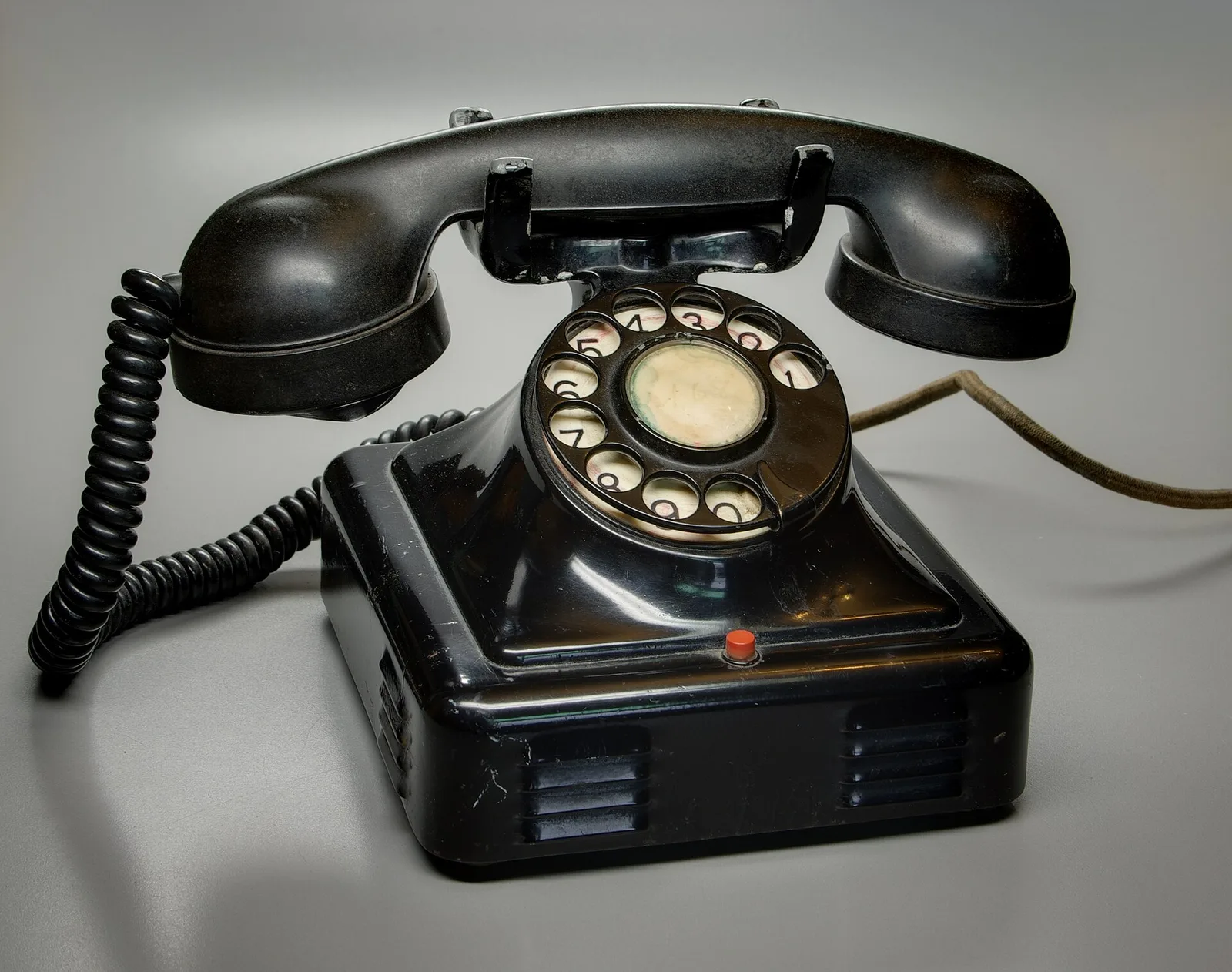
The telephone is a device that turns sound — above all the human voice — into electrical signals, transmits them over distance, and reproduces them at the far end, letting two people speak across a room or an ocean. Alexander Graham Bell was first, in 1876, to be granted a United States patent for a device producing clearly intelligible voice reproduction; others developed the instrument further, and it became rapidly indispensable in business, government and households. Its essential elements are a transmitter that converts voice to signal, a receiver that converts signal back, and a network that connects any caller to any other — first by operators plugging cords, then by automatic switching. The telephone company grew into the largest corporation of its age, wire by wire; it shaped etiquette, emergency services, the design of cities and offices; and its descendants — the mobile phone, then the smartphone in every pocket — still run on the same principle: your voice, converted, carried and restored.
Key facts
- Essentials: a transmitter converting voice into electrical signal, a receiver restoring it, and a network connecting any caller to any other.
- Patent priority: Bell's US patent was the first granted for clearly intelligible reproduction of the human voice at a distance.
- Lineage: the telephone grew out of telegraphy's harmonic-telegraph experiments, then outgrew the telegraph's networks.
- Modern form: the smartphone keeps the same voice-into-signal principle while carrying camera, computer and radio alongside.
In depth
Origins and preconditions
The telephone arrived out of telegraphy's workshop culture. Bell, a teacher of the deaf, was working on the harmonic telegraph — the idea of sending several telegraph messages over one wire at different pitches — when the problem turned inside out: if pitch could carry code, could it carry voice? In 1876 he was the first to be granted a United States patent for a device that produced clearly intelligible reproduction of the human voice at a second device. The patent's timing and wording made it one of the most valuable in history, and rival claimants — Elisha Gray among them — produced a century of litigation. What mattered technically was the pair of transducers: a transmitter turning sound pressure into an electrical signal, a receiver doing the reverse.
The telephone's crucial step was not making sound electric but making it intelligible. Bell's harmonic telegraph tried to send several messages at different pitches over one wire; the insight that a continuous undulating current could carry the shape of a voice turned the problem around. The patent of 1876 was contested — Elisha Gray filed a caveat the same day — and the lawsuits lasted decades, but the technical achievement was real: a transmitter and receiver that reproduced speech well enough to be understood. The telephone was thus a by-product of telegraphy's ambition to squeeze more signals out of a wire.
How it worked
A telephone is a system, not a gadget. The transmitter converts the pressure waves of speech into an electrical signal — early designs varied resistance with a carbon diaphragm; later ones used electromagnetic induction. The receiver reverses the process, driving a diaphragm with the signal so the far end hears a voice rather than a hum. Between them runs the network: dedicated wires at first, then switchboards where operators plugged cords to connect any two subscribers, then automatic switching that made the network self-operating. Signaling — ringing, dialing, busy tones — grew up alongside speech, and the whole edifice assumed a level of signal fidelity that speech, unlike code, demands: intelligibility, not perfection, was the design target.
The telephone network is a hierarchy of switches. A call begins at a subscriber loop, reaches a local exchange, and is routed through progressively higher-level switches to its destination. Early exchanges were manual — operators pulled cords — then electromechanical, then digital; the principle stayed the same: a dedicated path for the duration of the call. Signaling grew into a separate system (dial tone, ringing, billing), and long-distance transmission moved from copper pairs to coaxial cable, microwave, optical fibre and satellites. The network's value is proportional to the number of subscribers it can reach, which is why interconnection and standards mattered as much as the instrument.
Diffusion
The telephone became rapidly indispensable in business, government and households — the article's own phrase. Exchanges appeared first where commerce clustered; leased wires connected offices before homes; and the Bell company grew by integrating equipment, local exchanges and long lines into a single system — the largest corporation of its era. Automatic switching removed the operator bottleneck and let networks scale to millions of subscribers. The mode went mobile in stages: radio-telephony, then cellular networks, cut the telephone's last tether to the wire, and the smartphone merged the instrument with the computer. Each stage kept the same core pair — transduce, transmit, restore — while the network around it changed almost beyond recognition.
The telephone spread through business first and households second. Exchanges clustered where commerce was dense; leased lines connected offices before homes; and the Bell system integrated equipment, local service and long distance into a single company — the largest of its era. Automatic switching in the twentieth century removed the operator bottleneck and let networks scale to millions. The mobile revolution then cut the last wire: cellular networks made the telephone personal, and the smartphone merged it with the computer. Each stage preserved the core pair of transducers while changing the network around them almost beyond recognition.
Impact and legacy
The telephone changed the shape of conversation and, through it, the shape of cities and companies. Businesses centralized on the switchboard; emergency services standardized on a number; etiquette, greetings and even building design adjusted to a device that made distance immediate. Economically, the telephone system became the century's largest private engineering work — wires, exchanges, research laboratories whose side products included the transistor and information theory. Its social effect inverted the telegraph's: messages became ambient, presence-at-a-distance normal. The mobile smartphone completed the arc — the telephone stopped being a place and became a person — and the modern world, where a voice can cross the planet from a pocket, is simply the 1876 patent grown to planetary scale.
The telephone changed the shape of conversation and, through it, the shape of cities and firms. Business centralized on the switchboard; emergency services standardized on a number; social life acquired a new etiquette of availability. The network became the century's largest private engineering work, and its research laboratories produced the transistor and information theory as by-products. The smartphone completed the arc: the telephone stopped being a place and became a person. What remains constant is the promise Bell's patent made — that a voice can be present at a distance — now delivered from a pocket to a planet.
Timeline
- 1876–1885
Instrument and patent
Bell's patent covers a device reproducing the voice intelligibly; within a decade the telephone is a business instrument with exchanges and leased wires.
- 1876Bell patents the telephone
- 1885–1980
Networks and automatic switching
Operator cords give way to automatic switching; the telephone company becomes the age's largest corporation and the household's window to services.
- 1885The telephone becomes indispensable in business and households
- 1900Automatic switching scales the network beyond operators
- 1980–2007
Cutting the cord
Cellular networks untether the handset; the smartphone folds the telephone, camera and computer into one pocket device.
- 1980Cellular networks take the telephone mobile
- 2007The smartphone folds the telephone into a pocket computer
The last phase ends at its data cut-off; the entity window remains open to the present.
Connections
Influenced by
Related technologies
Related entries chosen for this kind of subject — shared context, place or period.
Sources
- Telephone — Encyclopaedia BritannicaAttribution
- History of the telephoneWikipedia (EN)CC-BY-SA-4.0
- TelephoneWikipedia (EN)CC-BY-SA-4.0
- Wikidata Q11035 — TelephoneWikidata · structured dataCC0-1.0
Reuse this data: open dataset (GeoJSON / CSV, CC BY 4.0)